The flight is $50 cheaper. Then you notice the bag, the airport an hour farther away and the arrival time that might require another night. The number that won the search results has stopped answering the question you actually asked: what will it cost to make this trip work?
For a holiday visit, compare the journey you need rather than the smallest fare you can find. A higher ticket price can come with a lower complete cost. A low fare can also remain the better fit after everything is added. The useful answer depends on your baggage, dates, transport and actual commitments, not on which offer wears the biggest discount label.
This U.S. consumer guide uses original, invented U.S. dollar examples, checked on October 26, 2026. They are teaching scenarios, not live quotes, typical fees or a recommendation to travel. No calculation predicts what your flight will cost tomorrow.
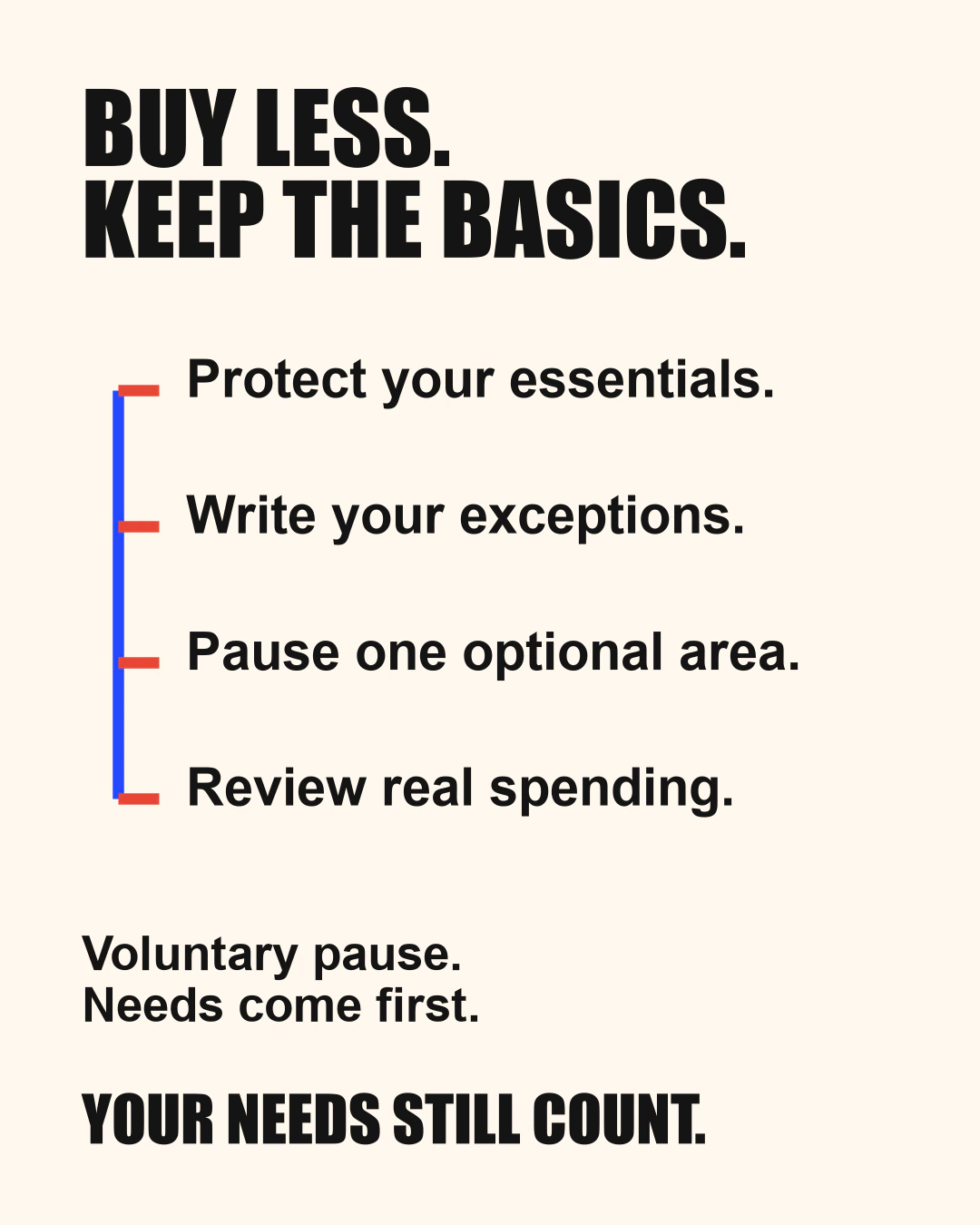
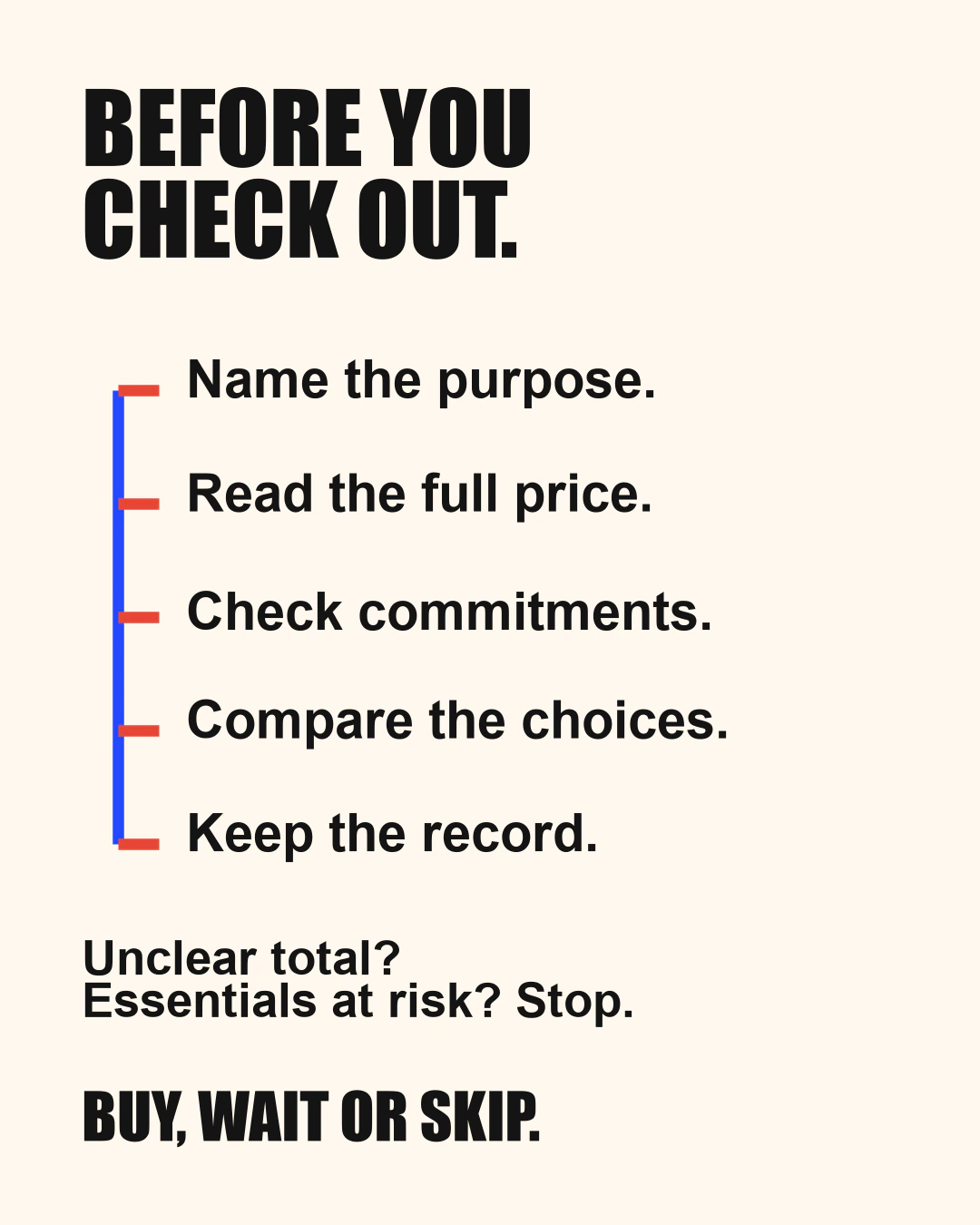
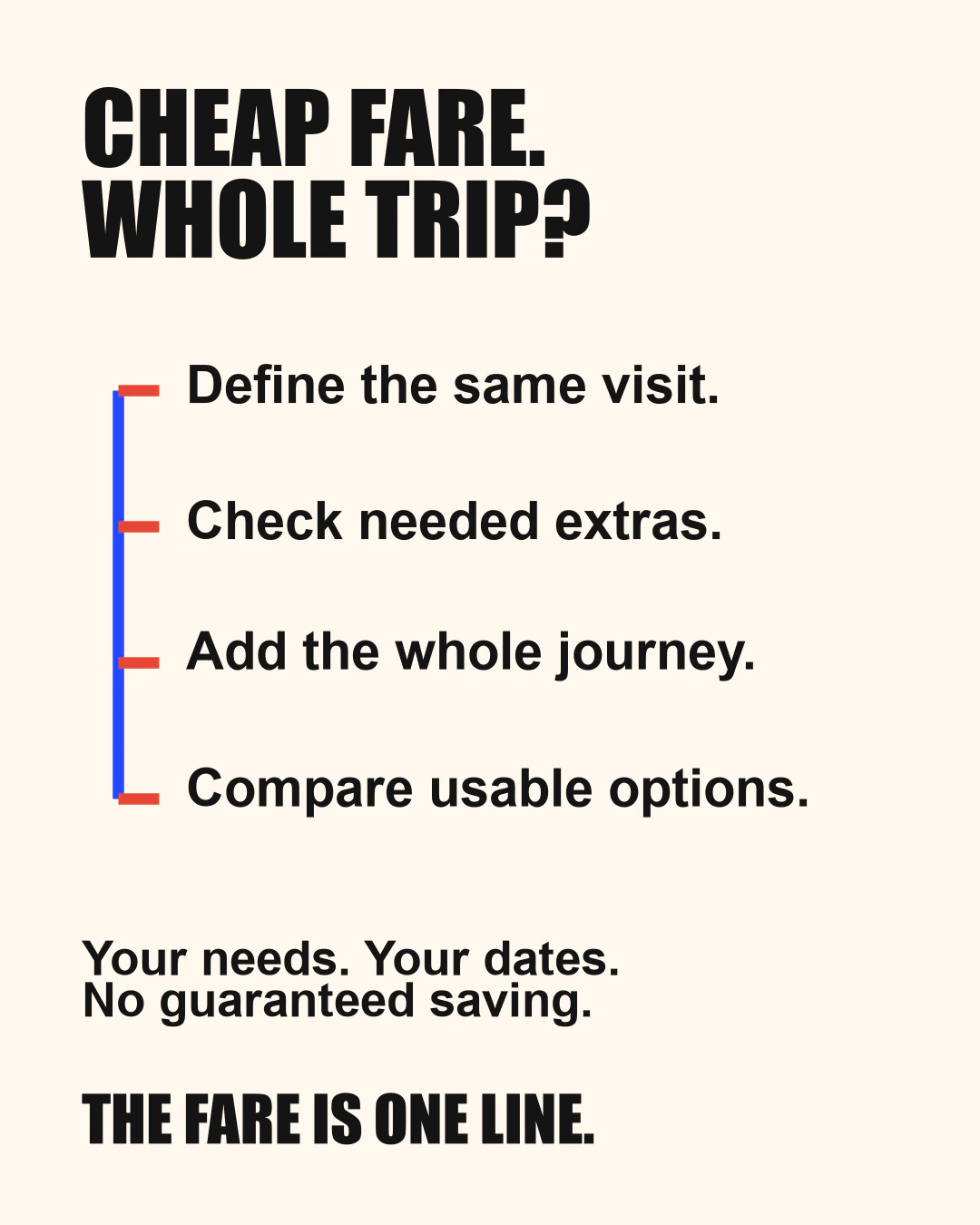
Original consumer comparison sequence: define the visit and actual needs before comparing complete costs. The connected rail organises decisions; it is not a measured effect, guarantee of saving or recommendation to book. All real services, terms, prices and payment dates require verification.
Text equivalent: Text equivalent: CHEAP FARE. WHOLE TRIP? Define the same visit. Check needed extras. Add the whole journey. Compare usable options. The qualifier reads Your needs. Your dates. No guaranteed saving. The punchline is THE FARE IS ONE LINE. This original qualitative order does not claim the smallest fare is always worse or a higher fare always better. Compare the same party, return-trip unit, workable times, necessary baggage and arrangements. Optional keeping, revising, waiting or skipping can be suitable. Five original documents/four publishers provide seasonal context and consumer principles, not travel-cost outcome studies. Google authored commercial context is separate from excluded AI summaries, booking-window/savings percentages and future-price guarantees. Current U.S./USD/date and complete assumptions remain in the article.
Who this is for
Use this approach if you are deciding whether two plausible holiday flight options fit the same visit and your spending plan. You might be comparing airports, fare types or a departure that changes how you get home. Start with your actual needs, including necessary assistance, care, accompanying travellers and work or family obligations. Those needs are part of suitability, not extras to discard to make a comparison look cheaper.
You can also decide to keep your existing arrangements, shorten a visit if that suits everyone affected, consider another feasible way to travel or skip an optional trip. This guide does not rank those choices for you. An essential journey and a discretionary break can have very different constraints.
It covers an original cost worksheet and questions to verify. It does not determine personal affordability, insurance cover, immigration requirements, legal rights or entitlement to a refund. For a specific policy, dispute or legal question, check the current official information and seek appropriate qualified help. No affiliate placement, paid booking recommendation or compensated product ranking is included here.
Before you start
Write the visit before searching the fare
Make a short private note: who is travelling, which places you actually need to reach, the acceptable arrival and return times, what you must carry and where you will sleep. Include any necessary seat arrangements, transport or other support. A departure that loses the only workable connection home does not meet the same brief simply because its flight is inexpensive.
Keep the comparison unit consistent. Write whether every quote covers one person or the whole party, one direction or the return journey. State the travel dates and what is included. A one-way number beside a return number is a mismatch, not a deal. Shared accommodation or a shared ride should be counted once in a party total, then allocated consistently if you also want a per-person view.
The Department of Transportation’s Buying a Ticket guidance discusses comparing fare types, restrictions and optional services. Use that as a reason to read the actual offer. Do not assume a fare label gives the same baggage, seating or flexibility on every itinerary. Check the seller, the operating carrier and the terms attached to the specific option you are considering.
Give a fare its proper job
Google published an authored holiday-travel article on October 5, 2026. It supplies timely seasonal context for this decision, not a forecast for your exact trip. Its platform commentary is not independent proof that a particular booking date will deliver the lowest price. You do not need a specific search account, paid alert or app to use this worksheet.
Historical fare averages answer another question. DOT’s Domestic Airfare Consumer Report explanation, updated May 29, 2026, describes each-way averages and exclusions including ancillary baggage, seat-upgrade and change charges. Those averages are not current quotes or complete holiday-trip budgets. None of the prices below comes from that report.
Actions in order
1. Capture two usable options
Record the quote, date and time checked, itinerary, fare type, seller and included services. Save the relevant terms privately so you can revisit the comparison without relying on a cropped search result. A screenshot of the opening number may omit the conditions that change the answer.
Mark unknowns clearly. If baggage, transport after arrival or a necessary arrangement remains unconfirmed, the total is incomplete. Put “verify” in the worksheet rather than zero. An unknown charge is not a free service. You can research an estimate separately, but label its source, date and uncertainty; do not present it as a confirmed offer.
2. Add costs that follow from your actual needs
Use the complete quoted ticket amount as the starting line. Add baggage you actually require, any suitable seat or service charges you choose or need, transport to and from both airports, parking and accommodation. Include relevant taxes and fees in the final amounts you compare. Check meals, necessary care arrangements or other costs if the itinerary changes them. Do not add a charge twice if the quoted amount already includes it.
Separate an existing expense from an additional one. A meal you would buy anyway and an extra airport meal are not automatically the same budget item. Likewise, a friend offering a ride is not a confirmed free transfer until the arrangement works for that person and the flight time. Record a reasonable alternative if the trip depends on a fragile assumption.
The FTC’s Online Shopping guidance supports checking total costs, offer conditions, sellers and records. Here those are general comparison habits. Its goods-shipping rules and payment-dispute details are not being applied as flight or hotel booking rules.
3. Compare one complete fictional visit
Here is an invented example for one adult’s complete return trip. All amounts are USD and assumed to include any relevant taxes or charges for their stated item. The two options serve the same planned visit and are assumed suitable before their costs are compared. Neither is a real airline, airport, hotel or quote. No borrowing, interest or currency conversion is included.
| Item for the whole return trip | Option A | Option B |
|---|---|---|
| Quoted return ticket | $160 | $210 |
| Required baggage, both directions combined | $80 | $0 additional |
| Ground transport for the full journey | $90 | $40 |
| Accommodation: two nights at $90 each | $180 | $180 |
| Other necessary incremental trip costs | $50 | $50 |
| Complete fictional total | $560 | $480 |
The ticket difference is $210 − $160 = $50, with A lower. Ticket plus baggage is $160 + $80 = $240 for A and $210 + $0 = $210 for B. Add ground transport and those journey subtotals become $240 + $90 = $330 and $210 + $40 = $250. A is now $80 higher, despite its cheaper fare.
The shared accommodation assumption is 2 × $90 = $180. Adding that and the $50 other-cost line gives $330 + $180 + $50 = $560 for A and $250 + $180 + $50 = $480 for B. The complete-cost difference remains $560 − $480 = $80. That is a conditional comparison between two invented totals, not $80 someone has saved or money already available in an account.
The “$0 additional” baggage entry means the required baggage is assumed included in this fictional B quote. It does not mean all higher fares include baggage, that a real traveller needs none or that any airline will honour these figures. Replace every line with your verified circumstances before using a comparison.
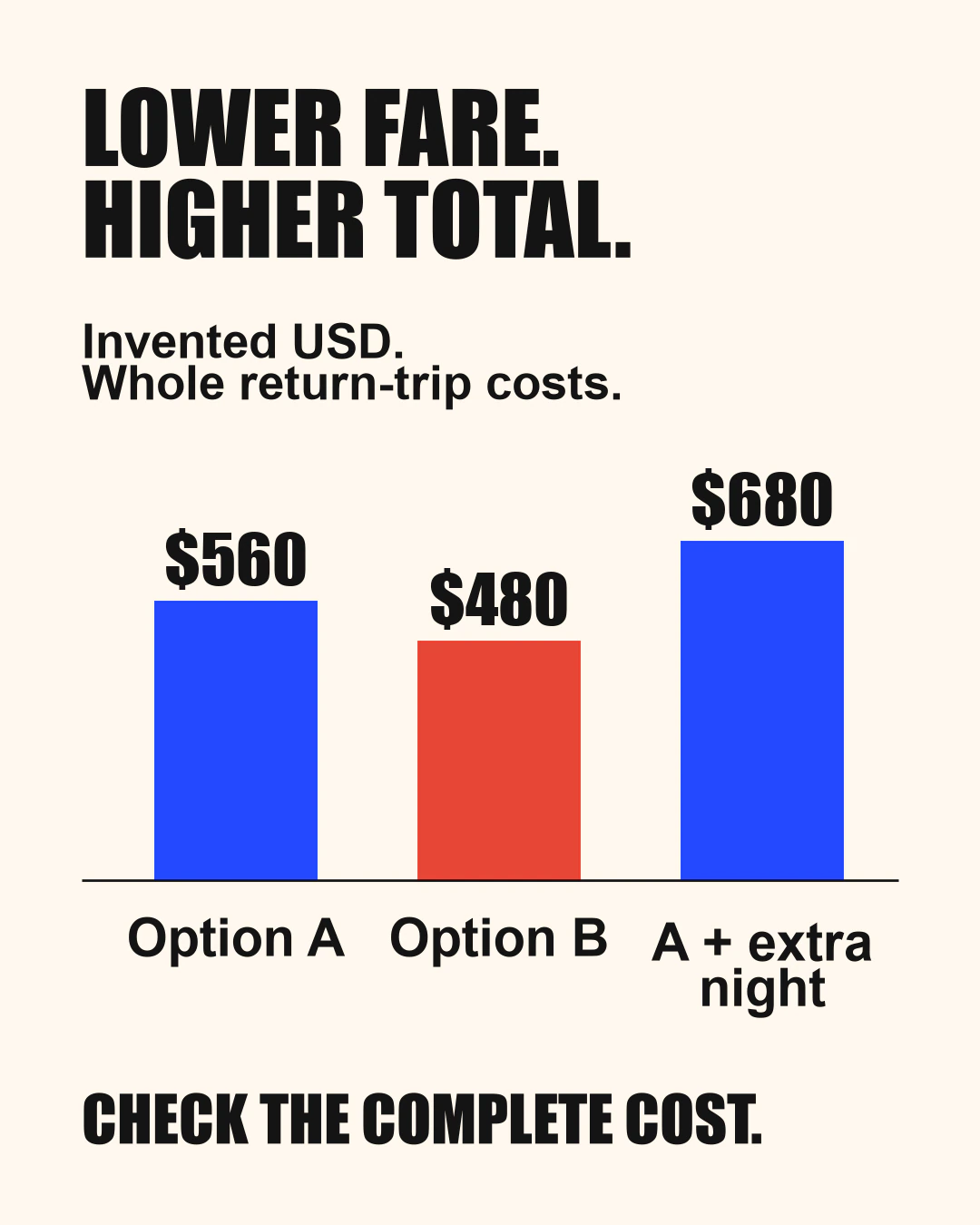
Invented one-adult complete return-trip USD model: A 160 ticket + 80 bags + 90 ground + 180 stay + 50 other=560; B 210 + 0 + 40 + 180 + 50=480. The third adds an entire assumed 120 extra-night cost to A, giving 680, and changes duration. No actual quote, typical fee, realised saving or booking recommendation is represented.
Text equivalent: Text equivalent: LOWER FARE. HIGHER TOTAL. Invented USD. Whole return-trip costs. Equal-width bars labelled Option A, Option B and A + extra night show $560, $480 and $680 at a shared zero baseline, 0.55 pixels per USD, blue/coral/blue. They are separate scenarios, not stacked fees or a historical trend. CHECK THE COMPLETE COST. The two base options are assumed suitable for the same planned visit. A 160 fare + 80 required baggage + 90 ground and B 210 + 0 additional baggage + 40 ground share 180 accommodation and 50 other necessary costs. All item amounts are invented complete totals with applicable charges assumed included, without borrowing, interest or conversion. The third is a separate changed-duration test, not automatically the same usable visit:120 is the entire extra cost assumed here; actual additional meals, care and transport must be resolved or the option is incomplete. The article separately tests removing A baggage, changing B ground costs and available dated money. A difference is not realised saving or an affordability finding. Twenty outputs independently agree in Decimal and JavaScript. Sources provide principles/definitions, not these prices.
4. Change the assumption that could reverse the result
Suppose A genuinely meets the traveller’s needs without the $80 baggage cost. Its new total is $160 + $0 + $90 + $180 + $50 = $480. Compared with B’s unchanged $480, the difference is $0. The original result disappears. This alternative only fits if the necessary items can actually be carried under the verified terms; it is not an instruction to leave essentials behind.
Now return to the original A, with its required baggage. Suppose its schedule requires an additional night costing a complete $120. Its total becomes $560 + $120 = $680. This is a different schedule scenario, not a claim that delays happen at a particular rate. Check the extra night’s practical consequences before treating it as an acceptable substitute for the original visit.
An extra night changes the trip’s duration. It only belongs in your shortlist if that longer arrangement still meets your needs and commitments. Here the $120 is the entire extra cost assumed for this separate teaching variation. In a real comparison, check any additional meals, care and transport too. If those are unresolved, do not label the $680 figure a complete usable option.
Change B instead. If B’s full ground-transport cost is $120, its complete total becomes $210 + $0 + $120 + $180 + $50 = $560. The difference from original A is $560 − $560 = $0. If B’s ground transport is $150, its total is $590 and it is $590 − $560 = $30 higher than original A. Lower flight-related costs do not settle the ground-transport question.
Each variation changes one named assumption while keeping the others fixed. Do not combine favourable pieces from mutually incompatible schedules. A zero-cost ride that is available for one arrival may not exist for another. If several inputs change together, rebuild the complete option and check suitability again.
5. Check available money as well as the ranking
The least expensive suitable option can still be beyond your available trip money. MyMoney.gov’s Spend guidance supports a spending plan and comparing prices and quality; it does not set a universal travel allowance.
In a separate invented cash check, suppose $800 is available and $250 must remain for existing necessities and obligations. That leaves $800 − $250 = $550 for this trip scenario. Original A leaves $550 − $560 = −$10, a shortfall. Original B leaves $550 − $480 = $70, an unassigned remainder in this model. The example does not establish that B is affordable for a real household or that $70 is an adequate contingency.
Use your actual payment dates and funds available at those dates. A whole-trip estimate does not prove you can pay a deposit today or cover bills before the next income arrives. Keep an uncertainty allowance separate from confirmed charges. There is no single correct allowance here, and calling an amount a buffer does not create the money.
Myth or Real?

Claim
Social paraphrase: Ticket price alone is sufficient to establish the complete cost of a usable trip.
Verdict
FALSE
Facts
Required extras and the whole suitable arrangement must be checked; the lower fare can or cannot produce the lower complete total.
FALSE rejects sufficiency of the ticket number, not every low fare. Actual needs, services and terms differ.
An original social question asks whether U.S.-related flight searches can include optional seat and baggage charges when comparing options. It is an older question about the comparison problem, not evidence of current platform functionality or fares. This fact card tests a transparently reframed editorial absolute, not a quotation or a claim attributed to the questioner. DOT Buying a Ticket explains that fare types and optional services differ. FTC Online Shopping supports checking total costs, offer conditions and records as general consumer habits; its goods-specific shipping, payment-dispute and refund rules are not transferred to flights or hotels. Together these practical sources support checking actual required extras and the entire suitable arrangement. A ticket price by itself supplies no ground-transport or lodging amount. The original article illustrates the conditional reasoning with independently reproduced invented USD totals, not source-supplied prices or observed savings. FALSE rejects the ticket number as sufficient information; it does not mean every inexpensive ticket leads to a more expensive trip. Actual baggage needs, services, terms, suitable times and other obligations differ. Check complete quotes and payment dates; unknown costs are not zero. No source here establishes a future cheapest price, individual affordability, insurance coverage, statutory entitlement or reimbursement guarantee. Google seasonal context elsewhere is commercial authored commentary and not evidence for this verdict. The graphic prescribes no booking, paid app or public itinerary.
Takeaway
Compare complete suitable trip costs and verify actual funds and payment dates.
Sources
Claim discussion: Original U.S.-related question about including flight add-on fees in comparisons.
Evidence: Buying a Ticket; Online Shopping.
Checked 2026-10-26. Scope: U.S. general consumer cost-comparison education. Original social question is discovery only, not a quoted assertion/current demand metric. No actual fare, typicalfee, price forecast, statutory rights/deadlines, legal/tax/insurance/immigration or personal affordability judgment.
Costs, risks and stop criteria
Keep time and suitability visible
Write travel time beside the dollar total, including transfers and overnight changes. Time can matter without assigning it an invented hourly dollar value. A longer journey might interfere with work, care or rest; another person may reasonably accept it. Assess the actual arrangement with anyone affected rather than reducing their needs to a fee you hope to avoid.
A trip budget is also not the maximum imaginable loss. Changed plans, disrupted travel and terms that do not suit your circumstances can create costs outside the teaching model. Check the current conditions and suitable contingency options before committing. Do not infer that any reimbursement, free change, replacement booking or insurance payment is guaranteed.
Stop when the comparison stops being usable
Pause if a critical charge is unknown, the itinerary no longer meets the visit’s requirements, the seller or terms cannot be verified, or the plan depends on money that will not be available when needed. Recheck if a quote changes or expires. Your earlier worksheet remains a record of an earlier option, not an entitlement to buy it later.
If the plan would take money needed for food, housing, care or existing obligations, revisit the underlying plan. If an essential journey cannot be covered, appropriate official or qualified assistance may help you understand actual options; do not assume eligibility, a deadline extension or funding. New borrowing introduces costs and risks absent from this worksheet and requires its own assessment.
Waiting, changing an optional visit or keeping an existing booking can be legitimate decisions. Waiting might also mean a higher price or fewer suitable options. No historical trend or comparison worksheet removes that uncertainty. Avoid turning a seasonal headline into pressure to buy something you have not checked.

Original suitability and payment check derived from the article, with no promise of lower future fares, sufficient funds, free changes, reimbursement or assistance. Necessary arrangements and existing obligations take priority over winning a fare comparison; revise or stop if the option no longer works.
Text equivalent: Text equivalent: A LOW PRICE. A USABLE TRIP? Check times and needs. Verify unknown costs. Check payment dates. Protect other obligations. Unsuitable? Revise or stop. The caution is A quote is not a promise of savings. The punchline reads SUITABILITY COMES FIRST. Connected steps are an original consumer check, not a universal legal/financial rule or a quantified intervention. Unknowns are not zero. A whole-trip nominal estimate does not establish money available on the actual due date, personal affordability or an adequate contingency. Verify the actual seller, operating carrier, current option/needed services and terms. DOTfare/service guidance and report definitions, FTCgeneral shopping habits and FLECspending principles have bounded roles; no cancellation deadline, refund entitlement, coverage or goods-specific legal rule is asserted. No purchase, app/account or public itinerary is needed.
How to assess the result
Before deciding, ask whether the lowest complete total belongs to an option that genuinely meets the same brief. Can you trace every important line to a current quote, a confirmed arrangement or a clearly marked estimate? Have you kept shared expenses, return journeys and necessary services consistent? Can you pay the actual amounts when required while protecting other obligations?
After any trip you choose to make, compare actual costs with the worksheet. Note which charges changed, which assumptions failed and which costs were simply moved elsewhere. A difference between two quotes is not evidence of a realised saving if the more expensive option was never going to be purchased. Keep useful records privately; no public itinerary, account details or spending challenge is required.
A good result can be a suitable trip, a revised plan or an early decision that the numbers do not work. The ticket is one line. The decision belongs to the whole journey.
Sources
Five original publisher documents across four publisher groups were read; the two DOT pages share a publisher. These are platform commentary, official consumer guidance and a data-definition page, not five independent trip-cost studies. Accessed October 26, 2026. The equations, fictional prices and worksheet sequence are original educational material.
- Google: Wheels up: Trends and tips for 2026 holiday travel, authored October 5, 2026. Commercial platform seasonal context only. Labelled AI-generated summaries, booking-window and saving percentages, rankings and urgency claims are excluded.
- U.S. DOT: Buying a Ticket, updated September 26, 2025. Fare-type, restriction and optional-service checking only; no statutory entitlement or cancellation deadline is asserted here.
- FTC: Online Shopping, May 2023. General total-cost, seller, terms and record habits only; goods-specific rules are not transferred to travel.
- MyMoney.gov / FLEC: Spend, undated. Spending-plan and comparison principles, not a recommended travel budget.
- U.S. DOT: Domestic Airfare Consumer Report details, updated May 29, 2026. Each-way average definition and ancillary-cost exclusions only; no report average is a model input or current quote.
FAQ
Common questions
Does a cheaper ticket always mean a cheaper trip?
No. The complete result depends on your actual baggage, transport, accommodation, services and workable times. A lower fare can remain cheaper or become more expensive after those costs; compare verified suitable options.
Are the dollar examples current flight prices?
No. Every price and fee in the teaching model is invented. The base cases assume the same suitable one-adult return visit, while the extra-night variation changes duration. Replace each input with verified current circumstances.
Should I book because a historical price window says to?
A historical platform summary is not a guarantee for your exact trip or future fare. Check current suitable options, full costs, terms and payment dates. Waiting or changing optional plans can also change prices and availability.
Topic hubs
Tags