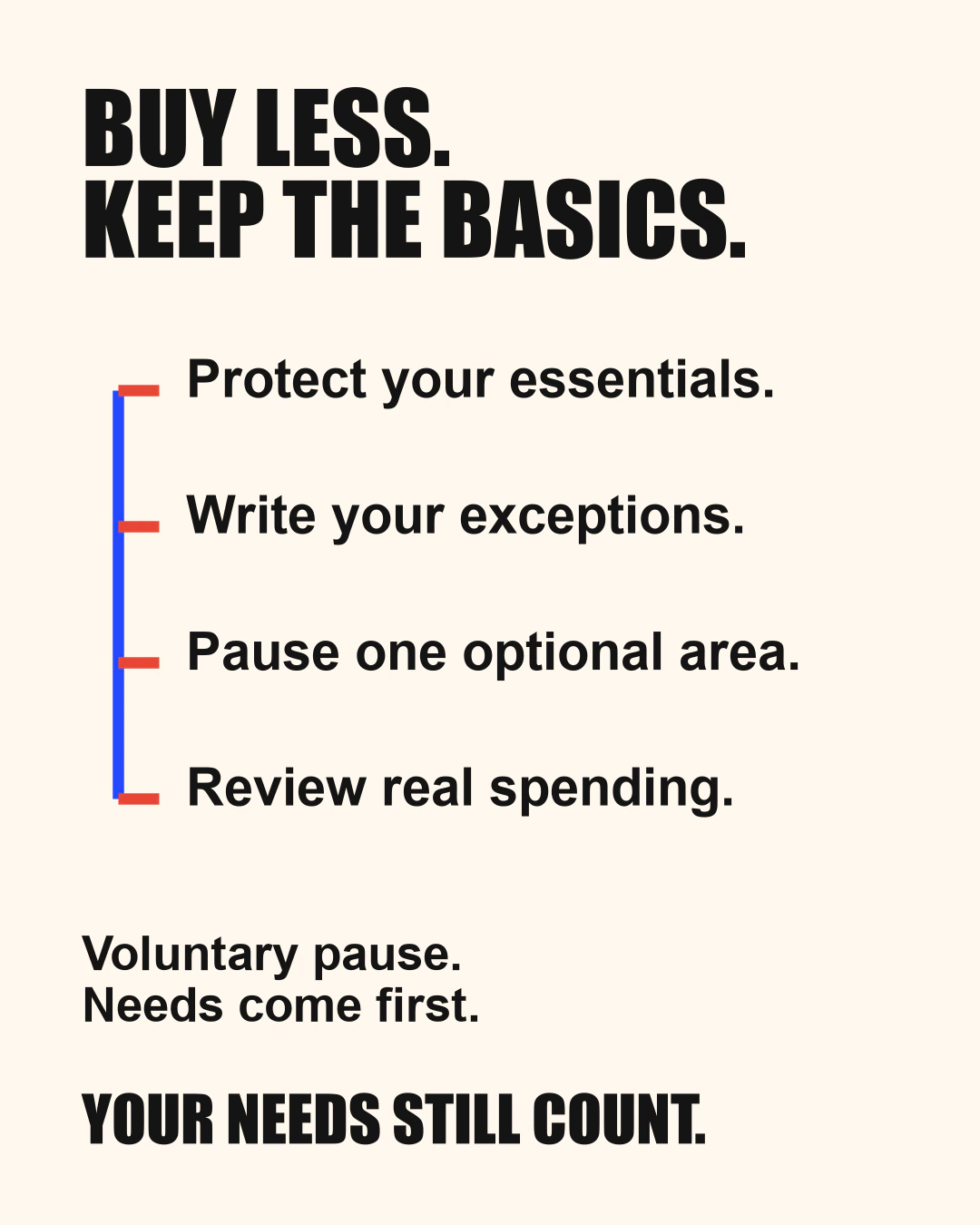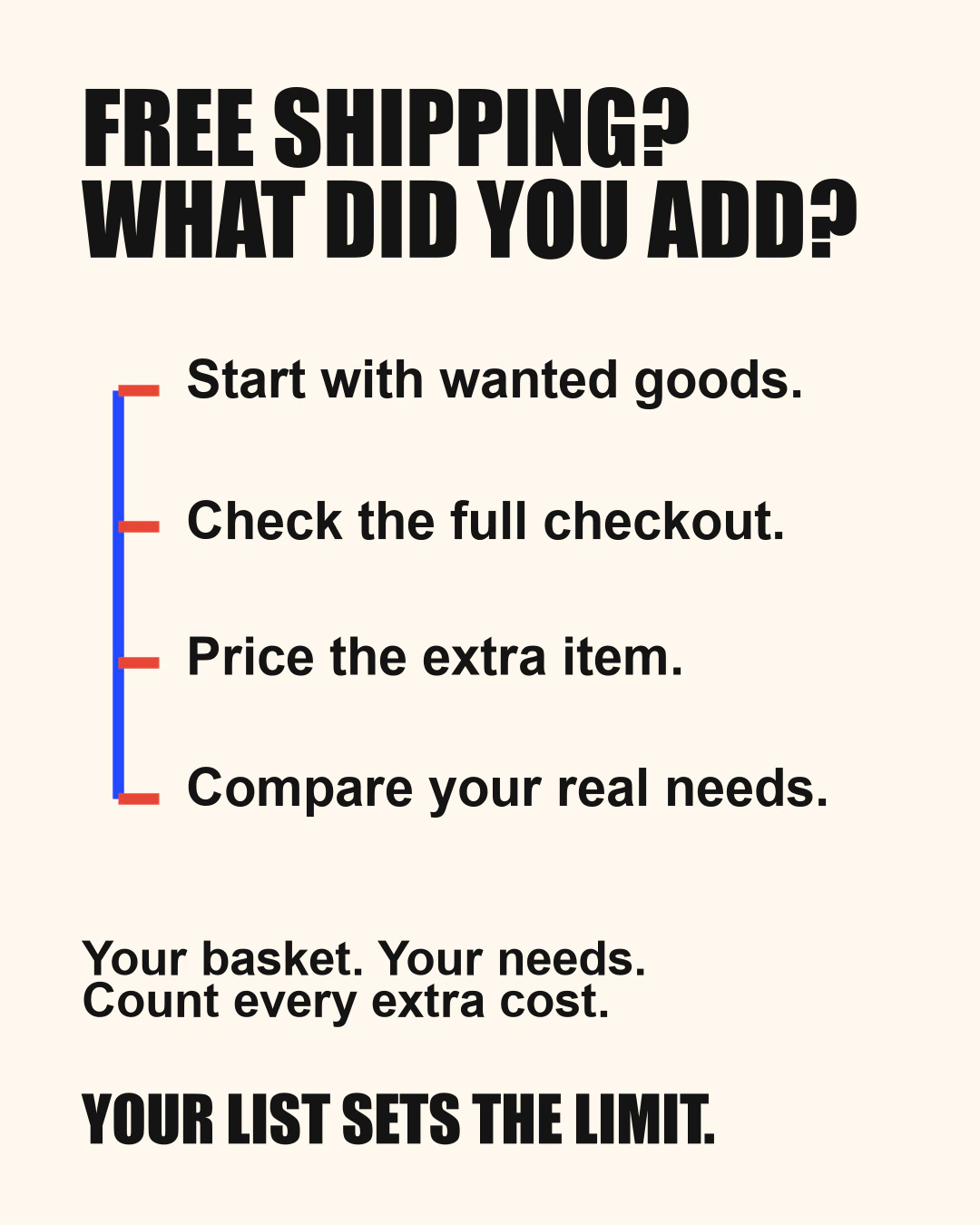
A countdown is running, your feed is full of gift ideas, and the basket suddenly feels urgent. Before checking out, write down the complete price and the money already set aside for that purchase. If either number is unclear, leave the basket open or close it while you check. A sale can expire without becoming an obligation.
This guide is for U.S. adults making an optional holiday purchase. It uses U.S. dollars and primary guidance checked on October 25, 2026. If you arrived here after a post about “doom spending,” the useful question is what to do with the next basket. This article does not diagnose a condition, explain your emotions or claim that a shopping pause treats a mental-health problem. It offers a practical decision process, with invented prices that are clearly separated from source guidance.
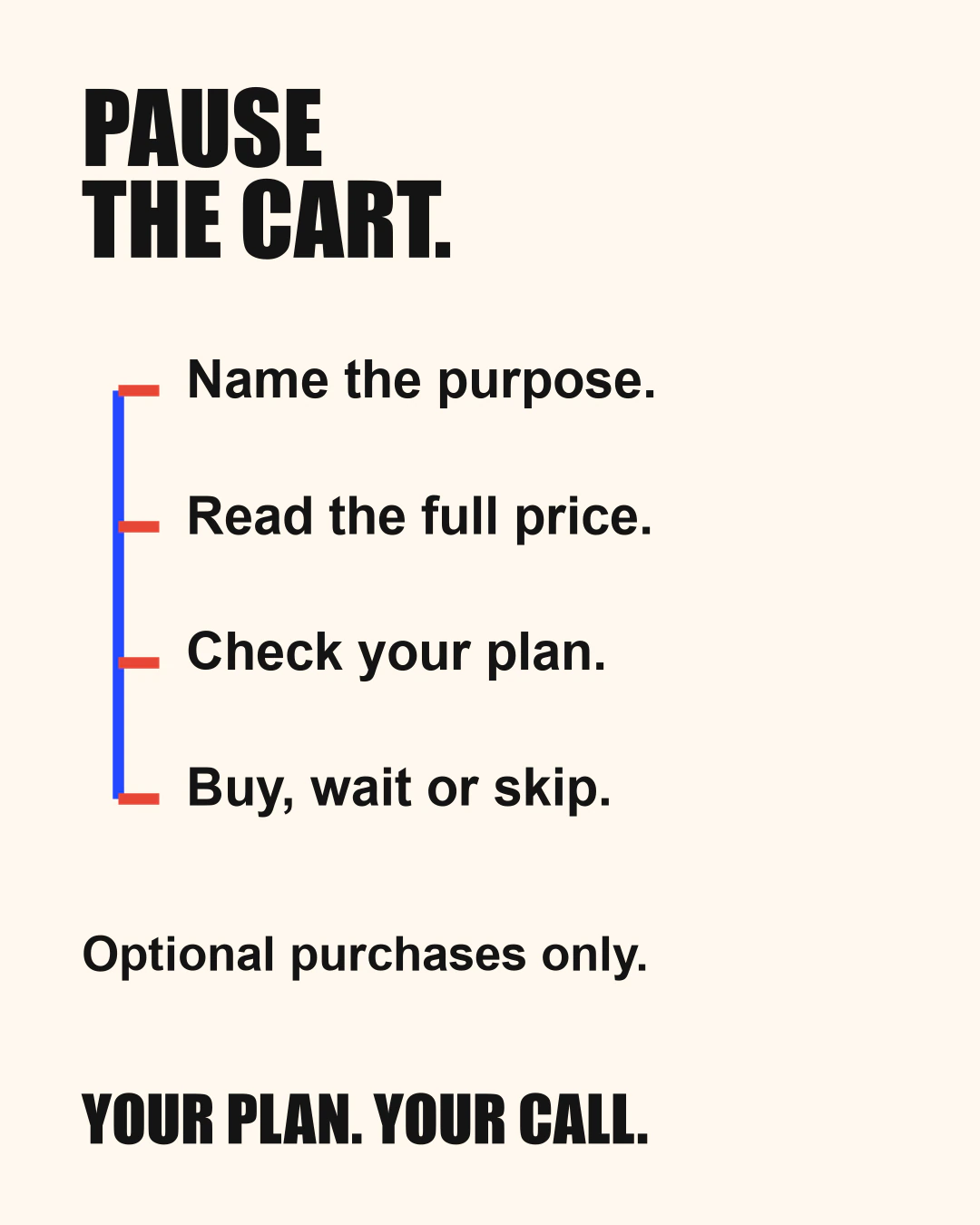
Qualitative overview for an optional U.S. purchase, checked October 25, 2026. Check the purpose, full price and existing spending plan, then buy, wait or skip. The rail shows reading order, not a measured effect of waiting.
Text equivalent: Start with the purpose of the optional purchase. Read the complete checkout charge and conditions. Check existing commitments in your own current spending plan; a bank balance alone is not an optional spending allocation. Choose to buy a suitable item, wait for missing information or buy nothing. These are original editorial reminders grounded in CFPB spending records, FTC complete-cost guidance and MyMoney.gov planning principles. No fixed waiting period, treatment, quantified saving or affordability clearance is encoded. United States/USD context, October 25, 2026; five original documents span three publisher groups. Complete source links and limitations remain in the article and sidecar.
Who this is for
Use this process when you have a choice about buying now, buying a different suitable item, delaying or buying nothing. It can help organize a gift, decoration or other optional purchase. It cannot establish that a household can afford its essentials or solve a shortfall in income.
An urgent replacement for something necessary deserves a different assessment from an extra item suggested by an app. Separate those situations before applying a holiday limit. A person’s needs depend on their circumstances; an online category or someone else’s budget cannot decide them.
The CFPB’s consumer spending worksheet describes several different spending challenges, including irregular income and difficulty tracking purchases. It recommends matching a spending limit to a budget and comparing actual spending with that plan. Those are recordkeeping tools. They are not evidence that every unplanned purchase has the same cause or that everyone needs the same restriction.
Before you start
Find your current spending plan, relevant account information and any purchases you have already committed to. Use a private note or paper; you do not need to give a shopping app access to your finances. Write the item, why you want it, the full expected charge and the point at which you will review the decision.
Do not treat the displayed bank balance as an available gift budget. Money may already be needed for bills, essential purchases, existing commitments or a savings contribution. Pending charges and the timing of incoming money can also matter. Use your own records to identify what is actually available for an optional purchase.
The CFPB’s spending assessment recommends checking real spending records, less frequent expenses and existing savings commitments. That page is written for people preparing to buy a home. Here, only its general recordkeeping approach is used; this guide makes no mortgage recommendation or claim about a safe amount to spend.
Choose a review time that suits the purchase and your circumstances. It might be after you have checked the bill calendar or talked through a shared gift plan. No particular number of hours is presented here as a proven cure for overspending. The purpose is to finish the checks before paying.
Name the fact you need to verify at that review: an upcoming charge, the delivered price or whether the recipient wants the item. Then use the information you actually find. A reminder to reconsider is a decision aid; it does not establish that waiting changes anyone’s spending behavior.
Actions in order
Name the purchase before naming the discount
Write the problem the purchase would solve. “A gift for someone who asked for this book” is more specific than “a good deal.” Check whether you already own something suitable, have already bought that gift or can meet the purpose another way.
Keep enjoyment in the decision. An optional purchase can be worthwhile without being essential. The question is whether you choose it knowingly within a plan that fits your circumstances. You do not have to invent a future productivity benefit to justify liking something.
The federal MyMoney.gov spending principles recommend comparing price and quality and caution against letting a discount prompt an unwanted purchase outside a spending plan. A crossed-out price does not answer whether this particular item belongs in yours.
Check the full basket, including the conditions
Record the product identity, quantity and final charge. Include applicable delivery, handling, tax and other charges. Check whether the price depends on buying extra products, joining a paid program or accepting a recurring subscription. Do not count a coupon unless you are eligible and it applies to the intended purchase.
The FTC’s online-shopping guidance recommends comparing total costs and reading deal conditions. It also advises checking seller-specific return terms. Before relying on a return, check the permitted period, condition requirements and possible return-shipping or restocking costs. Do not assume every sale item has the same policy.
A small installment displayed beside an item does not by itself tell you the complete cost or show that future payments fit your commitments. If payment terms are unclear, stop and read the actual agreement. This guide does not select a credit product, assess approval or calculate borrowing charges.
Compare the choices using one fictional example
Suppose an adult has already reviewed their own plan and allocated $60 for this optional purchase. That allocation is an invented input, not a recommended holiday budget or evidence of affordability. All other commitments are outside this small illustration and must have been considered separately.
The chosen item has a fictional price of $40 and a fictional delivery charge of $8. Assume no additional charges, equal product suitability and no financing. The checkout total is $40 + $8 = $48. Subtracting it from the $60 allocation leaves $12. That remainder is unspent allocated money, not new income or a guaranteed saving.
| Choice | Invented product cost | Invented delivery | Total charge | Amount left from $60 |
|---|---|---|---|---|
| Buy the intended item | $40 | $8 | $48 | $12 |
| Add an unwanted $20 item | $60 | $8 | $68 | -$8 |
| Add $35 of goods to reach a hypothetical free-delivery threshold | $75 | $0 | $75 | -$15 |
| Buy nothing now | $0 | $0 | $0 | $60 |
The negative figures describe an overrun of this fictional allocation. They do not show a bank-account deficit, an overdraft fee or a borrowing requirement. The example contains no account balance or payment agreement from which those outcomes could be inferred. If a real purchase would need financing, its costs and commitments require a separate assessment.
In this example, adding $20 makes the charge $68 and exceeds the allocation by $8. Reaching the invented $75 free-delivery threshold requires $35 of extra goods. It raises the total paid from $48 to $75: $27 more to avoid an $8 delivery charge. This comparison assumes the extra goods are unwanted and create no useful substitute for a planned purchase.
The result changes if those goods are genuinely needed and already budgeted elsewhere, but that requires a new comparison. Do not count the same allocation twice or assume a larger basket is justified merely because delivery becomes free. The table is an original teaching example, not an observation about a retailer’s current offer.
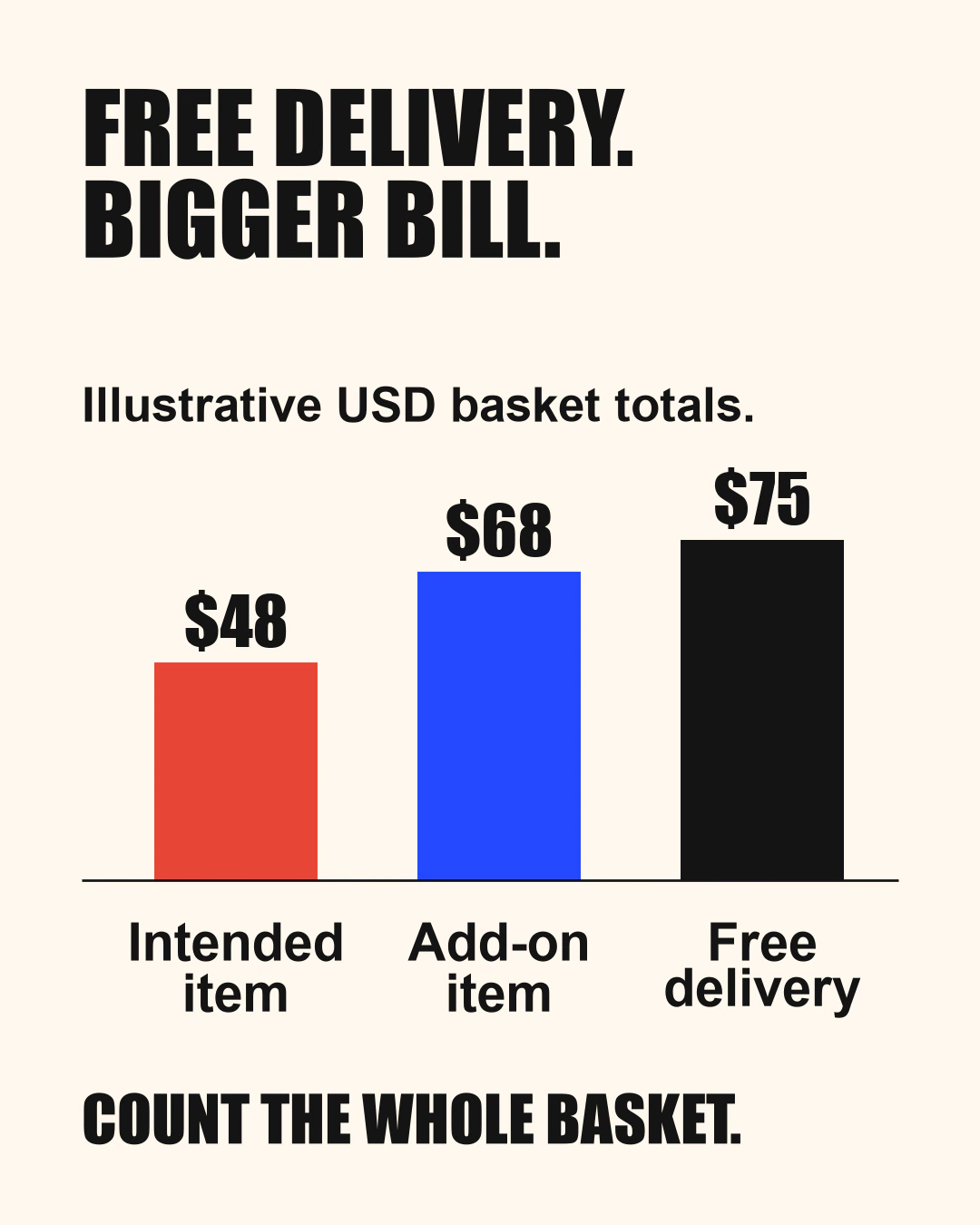
Illustrative USD totals, checked October 25, 2026: an invented $40 item plus $8 delivery costs $48; adding an unwanted $20 item costs $68; reaching an invented $75 free-delivery threshold costs $75. These are teaching assumptions, not retailer offers.
Text equivalent: All amounts are invented U.S. dollar examples. The intended item costs $40 plus $8 delivery, totaling $48. Adding an unwanted $20 item with unchanged delivery totals $68. Adding $35 of unwanted goods to reach a hypothetical $75 free-delivery threshold totals $75 with zero delivery. The last basket costs $27 more than the original $48 checkout to avoid an $8 delivery fee. Bars use exact totals, equal widths and one zero baseline at five pixels per USD. Products otherwise have equal suitability; other charges and financing are excluded only in this model. Needed goods budgeted elsewhere require a new comparison without double counting. The article separately models no purchase and an invented $60 optional allocation; negative allocation remainders do not establish a bank deficit or borrowing. Actual total charges and conditions must be checked. United States/USD, October 25, 2026. FTC and other linked primary guidance support checking full cost, not these invented prices.
Test a less convenient outcome
Replace the friendly assumption with a plausible less favorable one. If delivery on the original $40 item rises from $8 to $15, the total becomes $55 and the amount left becomes $5. A change that still fits the allocation leaves less room than the first calculation suggested. Recheck whether that tradeoff is acceptable rather than treating every amount below the limit as a target.
Alternatively, suppose a genuine, eligible coupon reduces only the $40 item by 20 percent. The item becomes $32; with unchanged $8 delivery, the charge is $40 and the remainder is $20. That is $8 less than the original $48 checkout. The coupon’s terms, eligibility and full final price must actually match those assumptions. No such offer is asserted to exist.
Also test the nonprice conditions: the item arrives too late for its purpose, the size is uncertain, a return would be costly, or a subscription continues beyond the initial purchase. A price comparison cannot repair a product that does not meet the intended need.
Make the choice away from the countdown
The FTC’s 2022 summary of its dark-patterns report identifies examples of misleading urgency and hidden charges. That establishes reasons to examine a sales interface carefully. It does not prove that every timer is false or that a particular seller is acting unlawfully.
Take the item details back to your note and compare them with your purpose and complete cost. If you return later, check the price and conditions again. Stock and offers can change; choosing time to verify can mean missing a genuine deal. That is a real tradeoff, not proof that the original purchase was necessary.
Choose one of four outcomes: buy the intended item, find a suitable alternative, review later or buy nothing. A lower-priced alternative still needs the same product, total-cost and suitability checks. Buying nothing does not require a replacement purchase elsewhere.
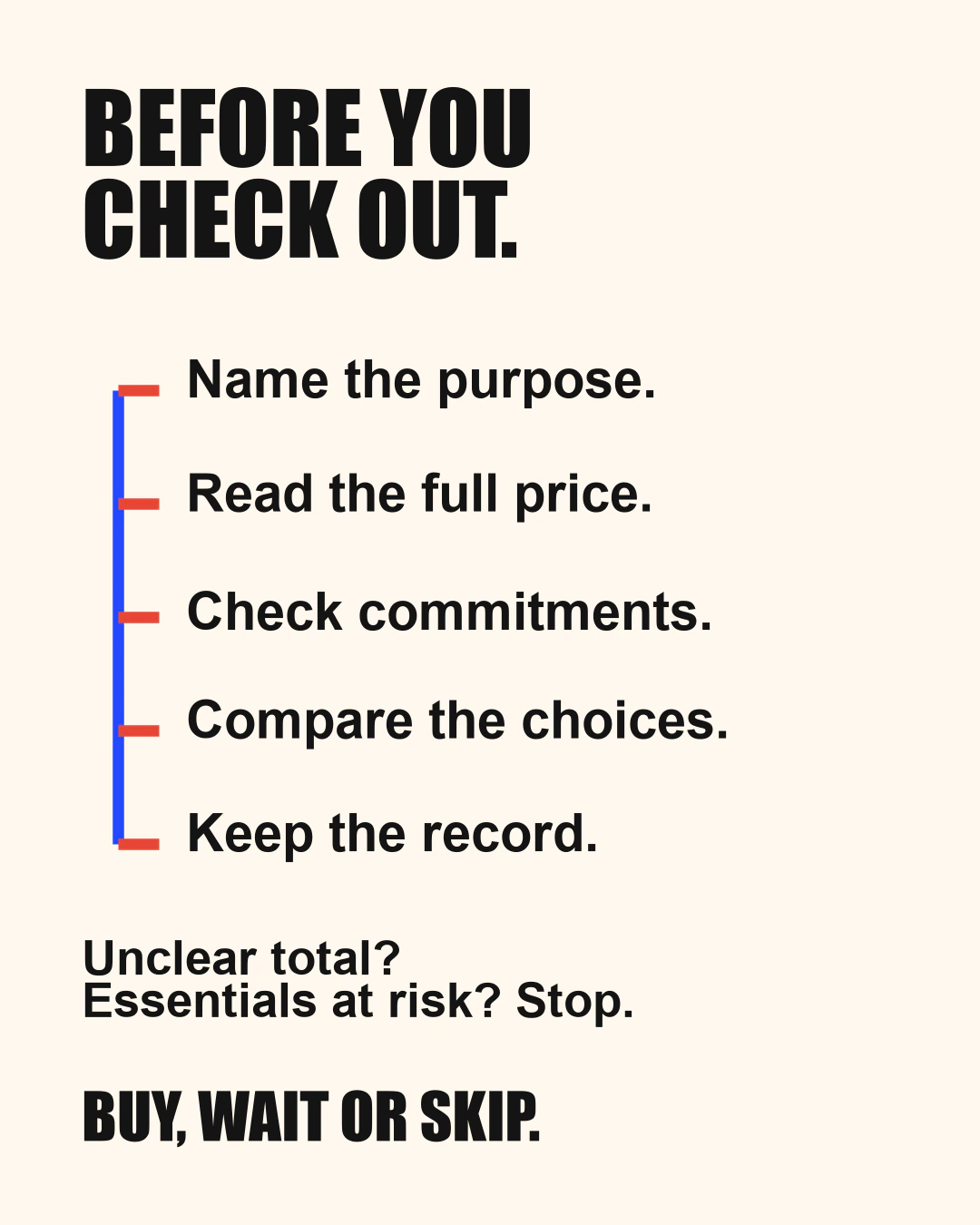
U.S. optional-shopping checklist, checked October 25, 2026: name the purpose, read the full price, check commitments, compare choices and keep the record. Stop the optional checkout if the total is unclear or essentials are at risk.
Text equivalent: Name the purchase purpose and check suitable things already owned. Read the complete checkout cost and seller conditions, including applicable charges, any unwanted additions or recurring commitment. Check current bills, existing purchases, savings commitments and uncertain incoming money in your own spending plan. Compare buying the intended item, a suitable alternative, reviewing later or buying nothing. Keep the actual charge and seller records if you buy; review the result against the plan. Stop an optional purchase if the complete charge is unclear, essential commitments would be displaced, incoming money is uncertain or the item does not meet its purpose. A self-chosen review time is a decision aid, not a proven behavior treatment. United States/USD, October 25, 2026. CFPB, FTC and MyMoney.gov/FLEC provide the linked educational guidance, not a personal affordability judgment.
Costs, risks and stop criteria
The process takes some attention and recordkeeping. You can keep it manageable by starting with one basket and a short list of facts. A detailed spreadsheet is optional. Avoid paying for a new subscription or buying another product just to begin checking a purchase.
Stop the optional checkout if the complete charge is unclear, the purchase would displace an essential commitment, the plan depends on uncertain incoming money or the product does not meet its purpose. If a shared plan is involved, clarify it with the relevant household member before spending money they also rely on.
Do not conceal a necessary expense to make a gift budget appear to work. If essentials already exceed available money, seek suitable local assistance or qualified financial guidance for that situation. A shopping pause is not a substitute for adequate income, debt assistance or individualized advice.
Keep account details, passwords and identity information private. You can record an item and its price without posting a bank screenshot or explaining your finances in a public comment. Pressure from an unfamiliar seller to rush a payment deserves additional verification through official consumer-protection resources.
How to assess the result
After a purchase, record the actual total and compare it with the plan. Keep the order confirmation, seller terms and receipt in a place you can find. If you delayed or declined, record that outcome too. An unspent allocation remains available only if it has not been committed elsewhere.
At your next money check, ask whether the information was complete, whether the item served its purpose and whether any other commitment was overlooked. Revise the estimate when the evidence changes. Do not describe the example’s unused $60 as “money earned,” or treat a smaller basket as proof that all financial concerns are solved.
The useful result is a deliberate choice with a known cost. It may include buying something enjoyable. This guide does not promise a particular amount saved, a reduction in distress or permanent behavior change. If managing spending feels persistently difficult, seek support suited to your circumstances instead of treating an online label as a diagnosis.
Myth or Real?

Claim
Social paraphrase: Adding goods to reach free delivery can increase the complete checkout cost.
Verdict
REAL
Facts
When extra goods cost more than the delivery fee removed, the checkout total increases, assuming no other price changes.
Compare actual totals and needed goods. This is conditional arithmetic, not a current-price claim or a judgment about value.
The selected social comment knowingly trades a delivery payment for a larger purchase of goods. It is used to discover the question, not to verify a retailer price or diagnose the shopper. FTC guidance says to compare complete costs and to check whether an offer requires unwanted goods. MyMoney.gov cautions against unneeded purchases outside a spending plan. The conditional arithmetic is straightforward: when the added goods cost more than the delivery fee removed and nothing else changes, the complete basket costs more. That inference supports the qualified possibility in the graphic. A higher payment may still buy useful goods; value, budget and product suitability remain separate decisions. Coupons, tax, delivery terms and other changed charges can alter the comparison. Original worked prices elsewhere in this article are invented and do not come from these sources.
Takeaway
Compare the complete baskets and decide whether the additional goods are actually useful within your plan.
Sources
Claim discussion: Social discussion of adding goods to avoid delivery charges.
Evidence: Online Shopping; Spend.
Checked 2026-10-26. Scope: United States household optional purchases in USD. Only a conditional possibility about complete cost is confirmed. Extra goods can have value, so a higher payment alone does not prove a bad choice. No observed offer, market frequency, universal saving or clinical inference is established.
Sources
This is general consumer education for the United States in USD, checked October 25, 2026. The horizon is the next optional purchase and the household commitments relevant to it. No current price, interest rate, tax rule, legal deadline or retailer promotion is supplied. Applicable charges and actual terms need checking at the time of purchase.
Five original documents across three publisher groups support the guidance. They are not five independent experiments. The older publication dates remain distinct from today’s access date. The shopping sequence and all prices and calculations are original editorial examples; no source is credited with providing them. No retailer, lender, affiliate, sponsor or referral arrangement funds or ranks the options in this article.
- CFPB: Consumer tips for managing spending, two-page worksheet: tracking, a budget-based limit and checking actual spending against a plan.
- FTC: Online Shopping: total cost, deal conditions, seller terms and purchase records; this article does not adopt its legal deadlines or recommend a payment product.
- MyMoney.gov: Spend: planning purchases and avoiding unwanted spending prompted by a discount.
- FTC: Dark-patterns report summary, 2022: examples of misleading urgency and hidden costs, without a current prevalence estimate or individual legal finding.
- CFPB: Assess your spending, a homebuying page used only for its general current-record and irregular-expense checks, without transferring mortgage conclusions.
Topic hubs
Tags