Your basket is almost there. A progress bar says another item will unlock free shipping, and suddenly you are shopping for something you did not come to buy. The delivery charge feels like wasted money. The extra purchase feels like getting something for it.
That feeling does not tell you which option costs less. If you spend $10 to remove a $6 charge, the checkout can rise by $4. You have an additional item, but you have not reduced the amount leaving your account. Whether that item is useful is a separate question from whether shipping became free.
Before filling the gap, compare the complete order you actually need. Sometimes paying delivery costs less. Sometimes combining an already planned purchase works better. Sometimes another seller, suitable pickup or leaving the basket alone is the useful option. The threshold does not get to choose your shopping list.
This U.S. consumer guide uses original, invented USD calculations, checked October 26, 2026. They are not current retailer prices, observed savings or a recommendation to order. No real merchant is assumed to offer the fictional terms below.
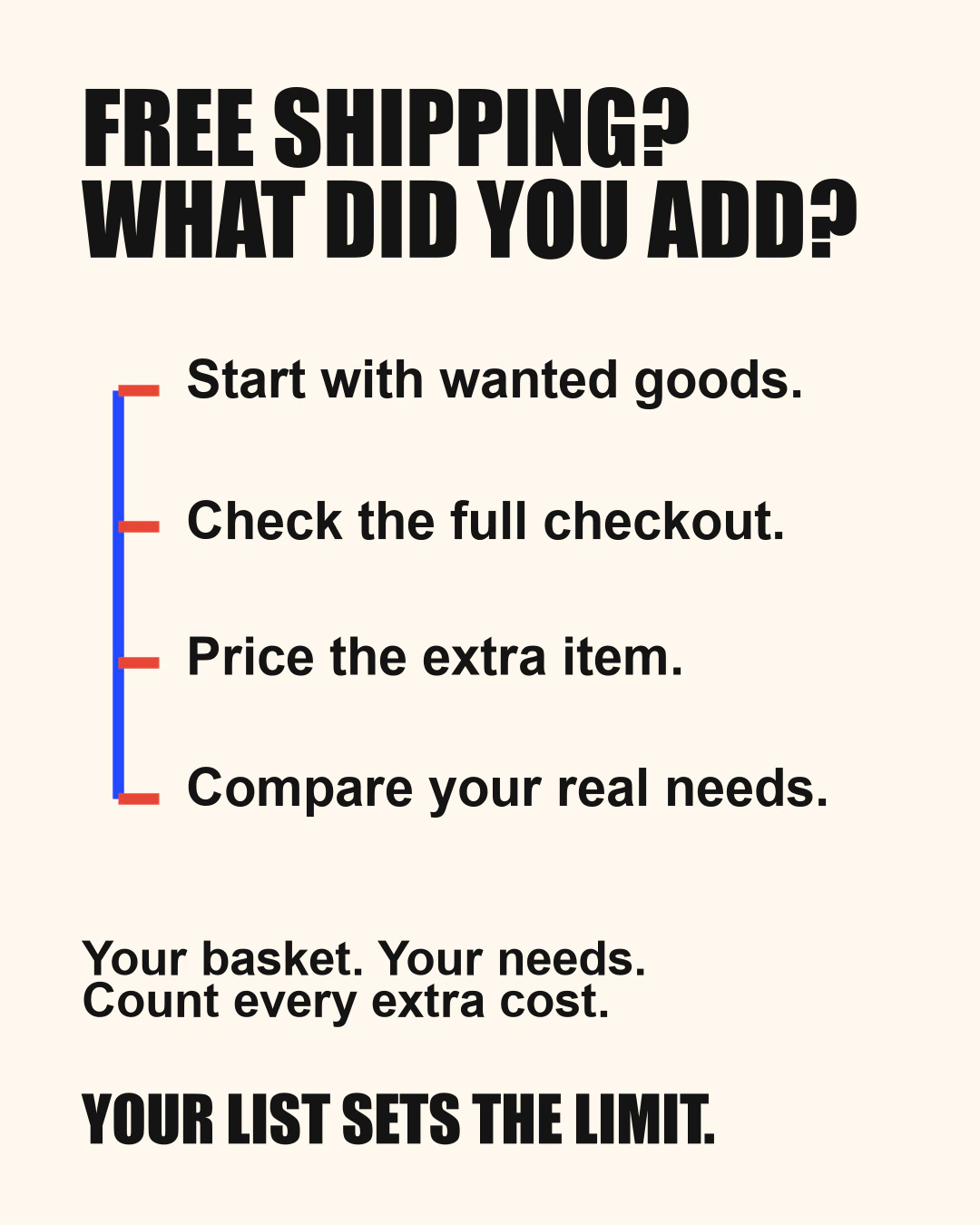
This original consumer sequence starts with the goods you intended to obtain, then checks complete checkout cash and the extra item. Its connected rail organises a comparison, not a measured financial effect or an instruction to order. Actual needs, eligibility, terms and payment dates govern.
Text equivalent: Text equivalent: FREE SHIPPING? WHAT DID YOU ADD? Start with wanted goods. Check the full checkout. Price the extra item. Compare your real needs. Your basket. Your needs. Count every extra cost. YOUR LIST SETS THE LIMIT. These are original qualitative decision steps, not evidence that every minimum offer is harmful or that any order is affordable. Check actual wanted goods, quantities, full charges and usable arrangements. An unwanted extra differs from an exact item already needed later; compare that case across a consistent period while checking cash due now. Five original documents/four publisher groups supply government education and commercial issuer/seasonal context, not trials. Two FTC pages share a publisher. Walmart shipping and store-delivery conditions differ; Amazon September 30 publication/October 6 update describes an already-ended October 6-7 event. No retailer fee, minimum, product discount, urgency, membership recommendation or measured growth is adopted. Keeping, revising, waiting or skipping an optional order can be suitable.
Who this is for
Use this guide when an online order minimum is encouraging you to add something. It can help with an optional holiday purchase, a household order or a gift basket you are still deciding about. Your actual necessities, required product features, access needs and payment dates come first. Buying a less suitable substitute to satisfy a threshold can defeat the reason for the order.
Start with a list of what you need and why. If a purchase is optional, keeping your existing plan, waiting or skipping it remains available. Waiting can also change prices, stock or delivery options, so it is not a promise of a better deal. For something time-sensitive or necessary, check the workable arrangements rather than treating the lowest number as the only criterion.
This is a comparison worksheet, not a personal affordability finding, tax assessment or interpretation of legal rights. For a specific dispute, policy or financial difficulty, use current official information and appropriate qualified help. No affiliate, sponsor, referral placement or paid retailer ranking is included here. You do not need to join a membership, open an account or buy anything to use the method.
Before you start
Find out which charge you are removing
Shipping, store delivery, a minimum-order charge and expedited service can describe different things. Check the actual seller, fulfilment method, location, eligible products and checkout terms. An order can reach an advertised merchandise minimum without removing every other charge.
Walmart’s current shipping and store-delivery help page illustrates why those distinctions matter: its member shipping and store-delivery descriptions have different conditions and exclusions. That is commercial issuer context, not a recommendation to subscribe or a statement that an offer applies to your order. None of its fee or minimum amounts supplies the model in this guide.
Record the eligible subtotal, the complete amount due and the charge you expect to disappear. Check whether a discount, excluded item or separate seller changes eligibility. If the effect remains unknown, mark it “verify.” Do not enter zero merely because a banner uses the word free.
Keep seasonal promotion in its place
Amazon’s fall and holiday shopping article was published September 30 and modified October 6, 2026. The event it describes ran October 6–7 and had ended by this guide’s check date. It is historical context within the current holiday-shopping season, not a live deal, a measured growth signal or a reason to rush.
Retailer promotion is not independent evidence that an extra item improves your finances. The article’s product discounts, lowest-price language, automated buying features and membership offers are not used here. You can make a private comparison with a note and the current terms in front of you.
Actions in order
1. Price the order without the extra item
Write down the exact goods you came for, their quantities and the complete cost of receiving them through a suitable method. Include relevant taxes, handling, delivery and any other required charges. Keep the version, size, condition, seller and arrival arrangement consistent when you compare alternatives.
The FTC’s Online Shopping guidance supports checking complete prices and whether an offer requires unwanted additional goods. Use that practical habit here. This guide does not assert a shipping deadline, refund entitlement or payment-dispute rule.
Save the current offer and terms privately. A checkout can change with the address, delivery method, seller or stock. Keep sensitive account and household information out of public screenshots. If a material amount changes, update the comparison rather than relying on the earlier total.
2. Compare checkout cash with checkout cash
Here is a completely fictional single-order model. The wanted merchandise has an eligible subtotal of $42. A $50 eligible-merchandise minimum removes a $6 shipping charge. All model items qualify, and no other eligibility restriction applies. There is no additional tax, handling or other charge in this invented transaction; that is an arithmetic assumption, not a real tax rule or an exemption claim. There is no membership, borrowing, interest or currency conversion.
The gap to the threshold is $50 − $42 = $8. That gap tells you how much eligible merchandise is missing. It does not tell you the price of the item you will find, its usefulness or the amount you will save.
| Fictional choice | Merchandise | Shipping | Cash due now |
|---|---|---|---|
| Buy only the wanted goods | $42 | $6 | $48 |
| Add an unwanted $10 item | $52 | $0 | $52 |
| Add an already-needed $8 item | $50 | $0 | $50 |
Without an extra purchase, $42 + $6 = $48. Add the unwanted $10 item and the total becomes $42 + $10 + $0 = $52. The shipping line has disappeared, but the checkout is $52 − $48 = $4 higher. Calling that a shipping saving does not make the whole order cheaper.
Under these simplified assumptions, the extra-item price that would match the original checkout is $48 − $42 = $6. However, an eligible $6 addition would not fill this particular $8 threshold gap. A break-even amount is useful arithmetic; it is not evidence that a qualifying product exists at that price.
An exact $8 addition reaches $42 + $8 = $50, still $50 − $48 = $2 more cash today than paying shipping. Whether that additional item is already needed changes how you assess the goods received, but it does not change the cash calculation. The three rows contain different baskets. They compare checkout amounts, not equal value or guaranteed savings.
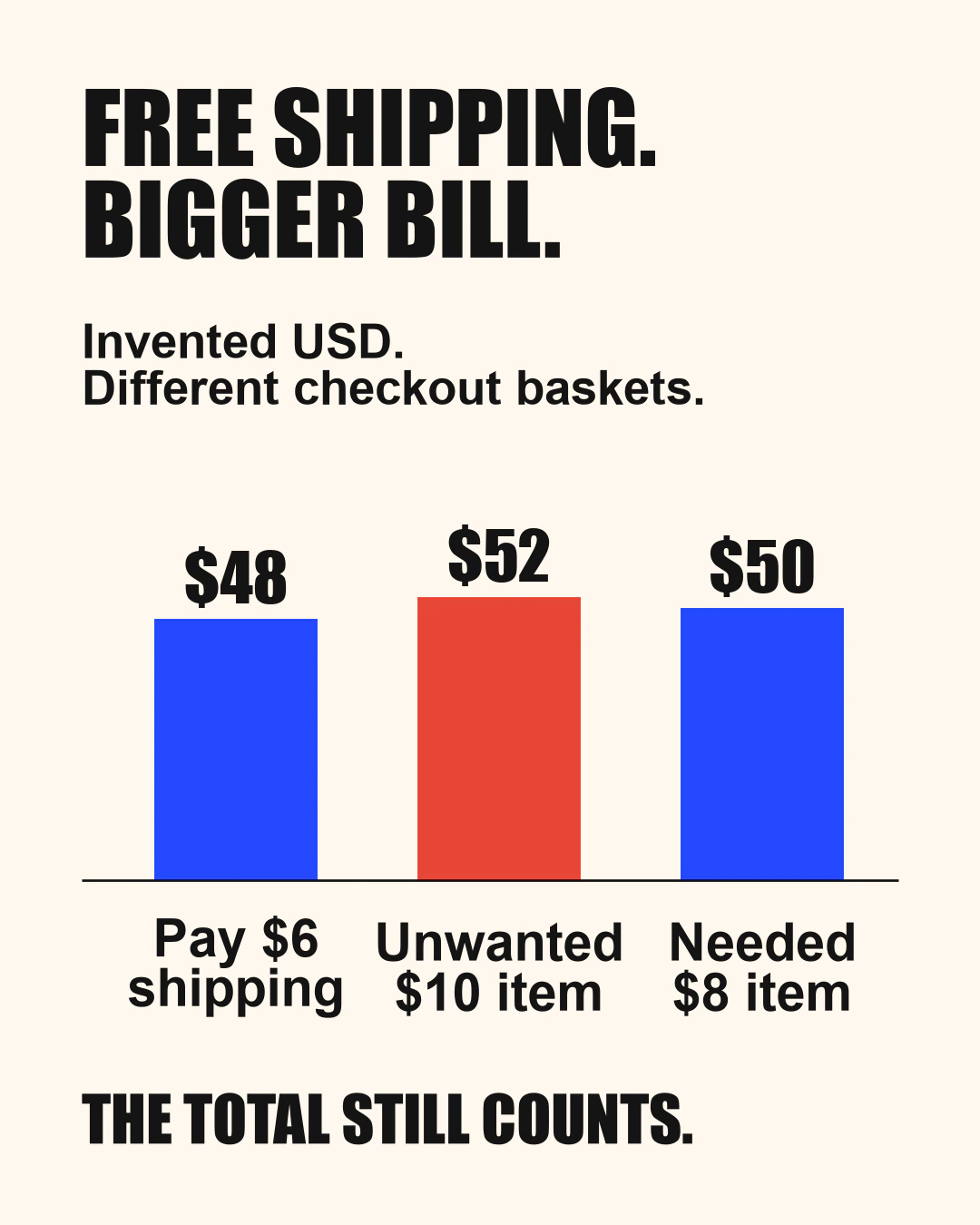
Invented USD checkout model:42 wanted merchandise + 6 shipping=48; adding unwanted 10 qualifies for zero shipping and costs 52; adding an already-needed 8 qualifies and costs 50. Different baskets, not equal value or savings. Fictional minimum 50, eligible items, no other tax/charge, coupon, membership or borrowing; actual terms require checking.
Text equivalent: Text equivalent: FREE SHIPPING. BIGGER BILL. Invented USD. Different checkout baskets. Equal-width bars labelled Pay $6 shipping, Unwanted $10 item and Needed $8 item show $48, $52 and $50 at a common zero baseline, 6 pixels per USD, blue/coral/blue. THE TOTAL STILL COUNTS. Original inputs are 42 eligible wanted merchandise, 50 minimum and 6 shipping;10 unwanted or 8 genuinelyneeded merchandise qualifies under this invented offer. No additional tax, handling or other charge is assumed; zero tax is arithmetic only, not an exemption or actual jurisdiction rule. Allitems eligible, no coupon/membership/credit. The bars compare different cash checkouts, not equal utility, observed prices or guaranteed savings. Needed 8 only replaces a future purchase if the same item/quantity/suitability/period genuinely apply and the later line is removed. Separate article scenario 48 now + 8 complete later=56 versus 50 combined is conditional; it does not lower today’s 50 payment versus 48 or establish realised saving. Small 5 addition fails this minimum; actual fees/eligibility/price/needs/dates may change. All 20 outputs independently agree in Decimal and JavaScript. Original government/retailer documents do not supply these prices.
3. Check that a smaller addition actually qualifies
Suppose you find a $5 item instead. Merchandise becomes $42 + $5 = $47, below the fictional $50 minimum. Shipping therefore remains $6 under the stated model. The checkout is $47 + $6 = $53, which is $53 − $48 = $5 more than buying only the wanted goods.
In that scenario you bought an extra item without removing the charge. Read the final basket calculation before assuming that any addition completes the progress bar. A coupon might also change the eligible subtotal or have different conditions. Verify its actual effect; this model assumes no coupon.
Avoid shopping until you find a convenient justification for the extra purchase. Ask whether you would still want the item if the order already qualified. Check what you own, whether the quantity will be usable and whether storage, expiry or care would create another cost. These are your circumstances to assess, not a rule that everybody should buy more of a household staple.
4. Treat an already planned item differently
An item you genuinely intended to buy can change the comparison across a longer period. Suppose the $8 addition is an exact needed item already planned for later in the same chosen shopping period. In this separate illustration, buying the wanted goods now for $48 and that needed item later for a complete $8 costs $56 across the period. The later $8 purchase is assumed to bring no additional delivery or travel charge.
Combining those goods now costs $42 + $8 + $0 = $50. Compared with the assumed $56 separate plan, the difference is $56 − $50 = $6. That conditional result depends on the later purchase actually being needed, usable and otherwise likely to happen at the assumed complete cost. It is not a record of somebody saving $6.
If you bring that exact needed item forward, remove its later purchase from the plan. Buying it again later would undo the replacement assumption. Keep the quantity, suitability and shopping period consistent. If you would not otherwise buy it, or would choose a different amount, rebuild the comparison rather than assigning the extra item an automatic future saving.
The earlier checkout is still higher: $50 today instead of $48 today. A whole-period advantage and a lower immediate payment are different things. If paying earlier would disturb another obligation, leave that consequence visible rather than hiding it inside a future-savings label.
If the extra item is unwanted, do not subtract its sticker price as though it were cash returned to you. If it will not replace a purchase you actually need, its price is an expense in this comparison. A product can have personal enjoyment or gift value without being money saved. Decide whether you want that purchase on its own terms.
5. Price a suitable alternative without inventing free access
Suppose another seller offers the same wanted goods for a complete merchandise price of $45, with $2 shipping and no other charge in this separate fictional case. Its checkout is $45 + $2 = $47, or $48 − $47 = $1 lower than the original wanted-only order. The merchandise price is higher; the complete delivered amount is lower.
That comparison only works if the goods, seller and arrival arrangements are suitable. A different size, condition, quantity or unreliable delivery does not become equivalent because its total is smaller. Keep any material difference beside the price instead of silently treating the products as interchangeable.
Now suppose suitable pickup keeps the original wanted merchandise at $42 but adds $5 of actual incremental travel cost, with no pickup fee or other added expense in the model. The complete cost is $42 + $0 + $5 = $47, also $1 lower than the $48 delivered order. A zero delivery line is not a zero-cost trip.
Do not assume pickup is feasible, free or convenient. Check access, transport, necessary care arrangements and time with anyone affected. Write time separately unless you have a reasoned basis for assigning it a dollar cost. If the extra journey would not be suitable, discard it rather than forcing it to win the worksheet.
Myth or Real?

Claim
Social paraphrase: A free-shipping label by itself establishes a lower complete checkout cost.
Verdict
FALSE
Facts
The cost of extra goods and all remaining charges must be included; removing shipping can leave a higher or lower complete total.
FALSE rejects the label as sufficient proof, not every offer. Needed goods, actual terms and payment dates differ.
An archived social discussion describes adding more goods to reach a free-shipping minimum while also noticing unwanted purchases. It discovers the comparison problem; it does not verify current retailer terms, fees or a financial outcome. This card tests a transparently reframed editorial absolute, not a quotation or an assertion falsely attributed to the original poster. FTC Online Shopping recommends checking complete costs and whether a deal requires unwanted extra goods. MyMoney.gov/FLEC Spend supports comparing price and quality within a spending plan and avoiding unneeded purchases prompted by a discount. These are practical education sources, not shopping intervention trials. Their guidance and ordinary conditional arithmetic support rejecting a free-shipping label as sufficient proof of a cheaper checkout: an additional item can cost more than the charge removed. The article separately uses independently reproduced invented USD scenarios, not source-supplied prices or observed savings. FALSE does not mean that every minimum offer costs more. A genuinely needed item can replace a later purchase under suitable actual terms, but that later line must be removed and the same goods, quantity, suitability and period compared. Earlier checkout cash can still be higher. Unknown fees are not zero; a possible refund is not money available now. Protect necessities and payment dates. Walmart issuer distinctions and Amazon historical seasonal promotion elsewhere provide context, not evidence of savings or recommendations to subscribe. No tax exemption, statutory deadline, refund entitlement, personal affordability or compulsory order is asserted.
Takeaway
Compare the complete bill for suitable actual needs, including any additional purchase.
Sources
Claim discussion: Archived discussion of adding goods to a free-shippingminimum.
Evidence: Online Shopping; Spend.
Checked 2026-10-26. Scope: U.S.generalconsumereducation. Archiveddiscussion discovery only, not currentfees/eligibility/demand. No actualretailerprice, taxrule, legaldeadline/refundright, observedsaving, product/membershiprecommendation or personalaffordabilityfinding.
Costs, risks and stop criteria
Check money available before calling an option affordable
In a separate invented cash check, $100 is available and $55 must remain for other necessities and obligations. The amount left for this scenario is $100 − $55 = $45. The wanted-only $48 checkout leaves $45 − $48 = −$3. The unwanted-filler $52 checkout leaves $45 − $52 = −$7. Both show a shortfall within those assumptions.
Being less expensive than another option does not establish that you can pay for it. Use actual funds and due dates, and protect necessities and obligations. Credit or a payment plan introduces costs and risks absent from this example; it needs its own assessment. A free-shipping label does not solve a cash shortfall.
MyMoney.gov’s Spend guidance supports comparing price and quality within your own plan. FTC consumer.gov’s Making a Budget explains recording actual income and expenses and reviewing what happened. These are general educational sources, not proof that a specific order fits your household or that tracking guarantees enough money.
Stop if the comparison relies on an unresolved condition
Pause when an essential product feature, seller, eligible subtotal, delivery arrangement or important charge is unknown. Recheck if the final checkout changes. Free shipping may cover one named charge while other costs remain. A paid membership has its own cost and conditions; do not silently treat a new subscription as free delivery.
Do not base the purchase on returning an unwanted filler later. The relevant terms, return costs, timing and effect on the promotion need checking, and no refund or retained shipping benefit is assumed here. A possible refund is not money currently available for another bill.
Change the plan if it would delay food, housing, care or another real obligation, or if buying more would create waste or an unsuitable commitment. A necessary order may require a different practical solution from an optional gift. For an actual financial difficulty or policy dispute, seek appropriate official or qualified help without assuming assistance, an extension or a particular outcome.

This original decision sequence checks whether an extra item truly replaces a planned later purchase and whether the earlier payment fits actual obligations. No future price, refund, sufficient funds or saving is guaranteed. A comparison can lead to revising or stopping an optional order.
Text equivalent: Text equivalent: NEEDED LATER? CHECK TODAY. Match the same item. Remove its later purchase. Check funds due today. Protect your obligations. Unsuitable? Revise or stop. A later purchase may never happen. CHECK THE MONEY TODAY. Connections organise a consumer check, not a personal financial finding or legal rule. Avoid counting an item as both acquired now and purchased again later. Keep the exact required quantity, suitability and shopping horizon consistent; if the later purchase would not happen, its assumed cost is not money saved. A lower conditional whole-period cost can still require more cash at checkout. Actual available funds/dates and necessary expenses remain distinct from hypothetical comparisons. Sources are general FTC/FLECeducation plus bounded commercial issuer/seasonal context, not outcome trials. No subscription, paid app, public shopping record, compulsory purchase, promised refund, tax exemption or statutory deadline is prescribed.
How to assess the result
Before ordering, compare the complete amount due for the goods you genuinely intend to obtain. Is the extra item wanted independently? Does it qualify under the actual offer? If you are counting a later purchase as replaced, have you kept the same shopping period and checked the complete later cost? Can you meet the actual payment dates while protecting other obligations?
After a purchase you choose to make, compare actual records with the assumptions. Note extra delivery, travel, unused goods or a purchase merely shifted to an earlier date. A difference between two hypothetical baskets is not automatically a realised saving. You can also decide that the original order, a narrower purchase or no optional order was the better fit.
The useful number is the complete cost of a suitable plan. A shipping bar reaching its target is only one condition inside that decision.
Sources
Five complete original documents across four publisher groups were read. The two FTC pages share a publisher; these are consumer guidance and commercial issuer or seasonal material, not five independent shopping studies. Accessed October 26, 2026. The model prices, twenty outputs and comparison sequence are original educational material.
- FTC: Online Shopping, May 2023. General complete-cost, unwanted-product, offer-condition, seller and record principles; no statutory deadline, refund or dispute entitlement is asserted here.
- MyMoney.gov / FLEC: Spend, undated. Spending-plan and comparison guidance, not a universal household budget or guaranteed saving.
- FTC consumer.gov: Making a Budget, August 2024. Actual income, expense and review steps, not an outcome trial or affordability assessment.
- Walmart: Member shipping and store-delivery help, undated. Current issuer context for differing shipping, delivery, eligibility and exclusions only; no actual fee or minimum is adopted in the fictional model.
- Amazon: Fall and holiday shopping event article, published September 30 and modified October 6, 2026 according to its original metadata. October 6–7 event context only, already ended; no current deal, discount percentage, urgency, automated buying or membership recommendation.
Topic hubs
Tags