United States; USD; checked October 18, 2026. This comparison concerns an adult managing their own consumer credit reports. It is general education, not advice about an individual legal dispute.
Decision in brief
A credit freeze restricts access to a credit report for prospective creditors, subject to exceptions. A fraud alert leaves the report accessible and tells creditors to take steps to verify identity. The practical choice is how much control you want over a new credit application and how you will manage legitimate access. Both tools are free, and they can be used together. FTC
A freeze can suit someone who wants to restrict access between applications and can manage the necessary temporary lifts. An initial alert can suit someone concerned about identity theft who wants an identity check while leaving access available. Neither choice replaces monitoring existing accounts. An unfamiliar card transaction needs attention from the card issuer even if your credit reports are frozen. Experian
The useful question is specific: Which part of the problem am I trying to control? Opening a new loan using your information, a charge on an existing card, and access to an online banking login are different problems. A credit-report setting should not become the reason you postpone the appropriate response to an existing-account problem.
Comparable evidence
The table compares the same U.S. consumer tools on the same checked date. It does not compare paid identity-protection plans or claim that any provider was tested for fraud prevention.
| Criterion | Credit freeze | Initial fraud alert |
|---|---|---|
| Main mechanism | Restricts prospective-creditor access, with exceptions | Requests identity verification without blocking report access |
| Direct fee | Free to place and lift | Free to place |
| Set-up scope | Contact Equifax, Experian, and TransUnion separately for their respective files | Contact one of the three; it must notify the other two |
| Duration | Remains until lifted | One year; renewable |
| Legitimate new credit | Plan the relevant temporary lift | Expect the verification process to remain relevant |
| Existing-account fraud | Not a complete defence | Not a complete defence |
Mechanism, set-up and duration: FTC. Access exceptions and free lifts: CFPB. Existing-account limitation: Experian.
These are descriptions of rules and operating procedures, not measured reductions in your personal probability of fraud. No percentage benefit is assigned to either option. That distinction matters when a paid service uses broad protection language alongside the free tools.
Myth or Real?

Claim
Social paraphrase: Freezing a credit report does not prevent fraudulent activity on existing accounts.
Verdict
REAL
Facts
A credit-report freeze limits prospective-creditor access; it does not switch off an existing credit card.
Existing-account fraud remains possible. A freeze does not replace contacting the financial institution.
REAL concerns one narrow distinction: a freeze on a consumer credit report and controls on an existing card are different functions. The current Experian guidance warns about existing-account fraud and fraud that does not require a credit check. The current TransUnion FAQ distinguishes a credit-report freeze from preventing card charges and points readers to the issuer for that separate control. This does not certify any personal scenario in the thread, endorse other comment claims, guarantee every card remains usable, or show that any issuer lock prevents every kind of fraud. A freeze still has access exceptions, and an initial fraud alert also does not make existing-account monitoring unnecessary. Use independently reached official channels and contact the relevant financial institution promptly about suspected misuse. Do not send identity documents or credentials to someone merely because they contact you. Qualified help is appropriate for a personal dispute, deadline or authority issue. This is general education for U.S. adults managing their own credit reports, not an individual legal, financial or recovery plan. The two reused bureau documents do not add to the four main publications or establish experimental efficacy; the social thread discovers the claim only.
Takeaway
Contact the financial institution about suspected existing-account misuse; manage report protections separately.
Sources
Claim discussion: Public banking comment distinguishes report freezes from existing-account fraud.
Evidence: Experian fraud alert versus credit freeze: existing-account limitation; TransUnion freeze FAQs: report freeze and credit-card controls differ.
Checked 2026-10-18. Scope: The general distinction in the selected comment about existing-account fraud. Excludes its checking-account application diagnosis, bureau access assumptions, credential/PIN instructions, rankings, personal stories and legal outcomes.
Tradeoffs by criterion
Control over access
A freeze addresses the access stage of a credit application. If a prospective lender cannot obtain the report it needs, the application may be held up. That friction also affects you. A fraud alert instead leaves access available and adds an identity-verification requirement. Treating the two settings as interchangeable can lead to a surprise when you next apply. TransUnion
There are exceptions to a freeze. The CFPB names existing creditors, certain government entities, and credit-monitoring companies you have hired among those that can still see a file. It also distinguishes employment, tenant-screening and insurance requests from the federal free-freeze requirement. Avoid assuming that every background check follows a loan application’s process. CFPB
Ask the organisation requesting a report what kind of check it needs and which reporting company it uses. That conversation is more useful than lifting every freeze for an open-ended period because an application form mentions a credit check.
Administration and application timing
The freeze set-up task covers three separate files at the major nationwide bureaus. A confirmation from one is evidence about that file; it is not confirmation that the other files are frozen. Keep a short private record of where you made requests and their confirmed status. The record need not contain your full Social Security number or copies of identity documents.
TransUnion offers temporary lifts with a specified period, so the file can return to its frozen state after that period. Check the actual confirmation rather than relying on a calendar reminder alone. Its account instructions are specific to its own service; another bureau’s screen may use different wording. TransUnion
The CFPB describes a one-hour deadline for an electronic or telephone removal request and a three-business-day deadline for a mailed removal request. Those are processing rules, not a promise that your entire lending application or an identity-authentication problem will be resolved in that time. Leave room to confirm the correct file and access period. CFPB
Price and the cost of your time
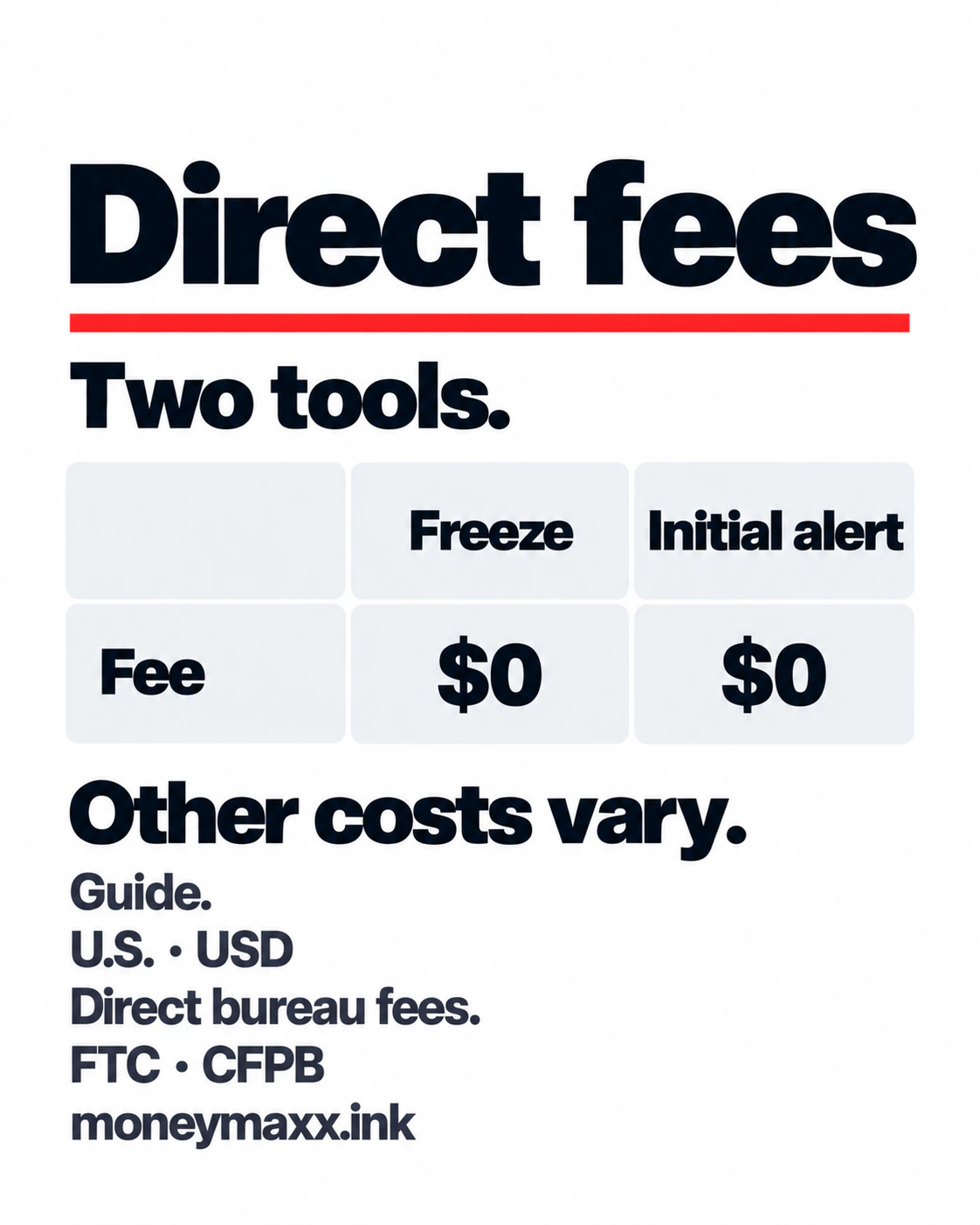
There is no direct-fee advantage to choosing the free initial alert over the free freeze. For a simple comparison, assume one placement at each major bureau and one later temporary lift at each. With the published free fees, the freeze ledger is:
3 × $0 placement + 3 × $0 temporary lift = $0 direct bureau fees.
The initial-alert placement fee is also $0. The inputs come from the agencies’ descriptions of these free services. This is a fee ledger, not a forecast of money saved by avoiding fraud. FTC, CFPB
Your time, internet or telephone access, and any postage or copying costs are outside that ledger. A paid monitoring subscription is also outside it. If a sign-up journey shows a monthly price, check which product is being offered before treating the charge as necessary for the freeze itself. There is no interest, investment return, tax deduction or inflation-adjusted payoff in this comparison. Assigning an invented fraud-loss estimate would create a misleading numerical winner.
Limits and renewal
An initial alert has an end date, so put renewal on your own calendar if you intend to keep it. An extended alert is a different option for people who have experienced identity theft and have the required FTC identity-theft or police report. It lasts seven years. This article does not assess anyone’s eligibility from a breach notice alone. FTC
Neither tool repairs an account takeover or ensures that every fraudulent application is stopped. Experian explicitly cautions that existing accounts and fraud without a credit check remain outside the tools’ protection. Keep reviewing financial-account activity and credit reports; a protection setting is not an all-clear signal. Experian
Who should choose each option
Consider a freeze when access control is your main aim. For example, a person with no immediate credit application may prefer to keep the relevant files restricted and arrange a temporary lift when necessary. The cost to plan for is the administrative task. Before choosing this approach, make sure you can recover access to the bureau accounts and understand how to confirm a lift.
Consider an initial alert when you want an identity check while leaving report access available. This does not make an alert equivalent to a freeze. It can be a more workable choice for someone concerned about identity theft who expects legitimate applications and is prepared to handle verification. Keep the contact details used for verification current and note the alert’s renewal date. TransUnion
Consider both when you want both functions. The tools are compatible. Adding an alert does not remove the need to manage a freeze for a legitimate application. No combined success rate is claimed here. FTC
Recognise what doing nothing means. Leaving the settings unchanged avoids a new administrative task, but it does not add either access restriction or an alert’s verification requirement. That is a separate choice from continuing to monitor your accounts. If you cannot complete a request online, investigate the bureau’s official telephone or mail route rather than assuming a paid intermediary is required.
As an illustrative decision, imagine an adult preparing to apply for a car loan. They already have freezes in place. The next useful action is to ask the lender which report it needs, arrange the appropriate temporary access, and confirm the result. Removing every protection permanently merely because an application is approaching would solve a broader problem than the one identified. This is a planning example, not a measured test or a recommendation about a particular lender.
Limitations and sources
Before acting, identify the problem, use an independently reached official bureau or agency site, and confirm the actual setting requested. Keep the distinction between a credit-report freeze and a card issuer’s transaction controls clear. TransUnion states that freezing its credit report does not freeze your credit card. TransUnion
If an existing account is being misused, contact the financial institution promptly. If identity theft has occurred, use the FTC’s official recovery resources and the relevant institutions’ procedures. Get qualified help for a legal dispute, a missed deadline, or a request involving another person’s authority. This comparison does not supply a legal strategy or a guaranteed recovery timeline.
The scope excludes child and protected-consumer procedures, business credit, and country-specific rules outside the United States. Bureau interfaces and documentation requirements can change. Recheck official instructions before submitting sensitive information or relying on a future application date.
Sources were checked on October 18, 2026. FTC and CFPB guidance anchors the consumer-rule description. Experian and TransUnion are primary sources for their own services and commercial organisations with additional products. They are not independent experimental evidence that one tool prevents a stated percentage of fraud. There are no affiliate links, sponsorships, referrals, compensation, or ranked paid plans in this comparison.
- FTC: Credit Freezes and Fraud Alerts.
- CFPB: What is a credit freeze or security freeze on my credit report?.
- Experian: Fraud Alert vs. Credit Freeze, dated June 2, 2026.
- TransUnion: Credit Freeze FAQs.

FAQ
Common questions
Does one freeze confirmation cover all three bureau files?
A confirmation from one is evidence about that file; it is not confirmation that the other files are frozen.
Which costs are outside the direct bureau fee ledger?
Your time, internet or telephone access, and any postage or copying costs are outside that ledger.
Does a report freeze switch off an existing card?
A credit-report freeze limits prospective-creditor access; it does not switch off an existing credit card.
Topic hubs
Tags