

United States; USD illustrations; sources checked October 17, 2026.
A rewards card can advertise a large points balance while offering little you would actually use. A modest cash reward may be easier to spend, but that does not make every cash-back card the better choice. Compare the benefit you can realistically redeem, the costs you would incur and the spending you already planned. The answer can change with a fee or an unavailable booking.
Decision in brief
Cash back may fit someone who wants a usable cash benefit with little redemption planning, provided the actual card’s fees, earning rules and payment terms work for them. Travel points may fit someone with suitable travel plans and an available redemption whose realistic value exceeds the extra costs. Keeping an existing card or applying for neither are valid options.
Start with repayment rather than rewards. If a card provides a purchase grace period and you are not carrying a balance, paying the balance in full by the due date can avoid purchase interest. Grace periods are conditional; carrying a balance can cause interest on new purchases too. Do not assume that a reward offsets borrowing costs or that every transaction has a grace period. [S2]
This is general consumer education, not an assessment of your creditworthiness or a recommendation to apply, borrow, transfer points or close an account. No named card or current offer is being ranked.
Comparable evidence
The comparison uses five government education pages from two organisations, the CFPB and FDIC. Several pages cover overlapping ground; they are not five independent product tests. The CFPB’s May 2024 rewards report summary identifies unexpected promotional conditions, devaluation, redemption difficulties and revocation among complaint themes. That historical complaint review does not establish how often a problem occurs among all cardholders, or which present-day card is best. Only the report’s landing-page summary was read here, rather than its full PDF or individual complaint files. [S1]
The FDIC explains that rewards can take the form of cash, points or co-branded benefits. Earning and redeeming follow program-specific terms, and expiration or forfeiture rules can matter. A headline multiplier therefore needs a second question: what can these units buy on the terms available to you? [S4]
For a fair comparison, use the same existing annual spending, realistic travel needs and time period. Compare recurring value separately from a first-year bonus. Include the current card as another option, with its actual costs and benefits. A card with no new application is not automatically free, and a new card’s advertised benefit is not automatically achievable.
Myth or Real?

Claim
Social paraphrase: The value of rewards can depend on program rules and whether a redemption is usable.
Verdict
REAL
Facts
Check actual reward terms and costs before counting a benefit.
A credit that requires unwanted spending may not replace an expense you would otherwise incur.
An archived travel-card discussion includes a note that a yearly credit does not offset an annual fee if it requires spending the person would not otherwise make. Only the selected search-rendered passage was read; the direct page was unavailable. The graphic is an editorial paraphrase of that conditional-usefulness issue, not a literal quotation or a claim that the author held a false belief. CFPB’s May2024 report landing summary lists promotional conditions, devaluation, redemption problems and revocation among historical complaint themes. Those themes are not population incidence or a current legal finding. FDIC’s historical Rewards Cards page explains differing earning, redemption, expiration and fee conditions. These main sources support checking terms and whether a benefit replaces a genuinely planned expense. A point balance or advertised credit does not establish that a suitable booking or eligible expense is available. Compare an acceptable cash alternative, subtract incremental costs once and keep existing/no-new-card options visible. Repayment capacity and actual account/grace terms need separate checks; rewards do not establish that borrowing is affordable. No named card, current offer, universal point value, actual booking or personal application decision is determined here. The article’s annual figures are separately verified hypothetical arithmetic and are absent from this graphic. Main S1 and S4 are reused, not additional independent product tests or government approval of the model.
Takeaway
Use planned spending and an acceptable available redemption; leave unknown conditions unresolved.
Sources
Claim discussion: Travel-card value: count benefits you would actually use.
Evidence: CFPB: Credit Card Rewards, report landing summary; FDIC: Rewards Cards.
Checked 2026-10-18. Scope: General U.S. consumer education. Reward terms, costs and actual usefulness can differ. Historical source periods retained. No current card/offer/rate/fee, universal point value, verified booking, personalised apply/borrow/close/transfer instruction, approval/credit-score/saving or legal outcome. Primary pages reused, not new independent trials.
Tradeoffs by criterion
Spend you already planned is the starting point
List purchases already in your budget, then check which qualify for each proposed earning rate. Category definitions, exclusions, caps and activation requirements belong in that check. Use the actual agreement rather than assuming that the merchant you regard as a grocery shop receives a particular rewards classification.
The FDIC recommends comparing APRs, fees and other terms while staying within a spending budget. It also points out that cash advances can bring separate fees and interest costs. A rewards calculation is not a reason to use a cash advance or spend money that is needed for essentials. [S3]
For a bonus, ask whether existing planned purchases would satisfy the actual qualifying rules and deadline. Extra spending has a cost even if it earns points. Do not put a one-off welcome bonus into every later year’s comparison, and do not assume an advertised offer means that you personally qualify. [S4, S5]
Value the trip you would choose
For a proposed redemption, identify a booking you could actually use: the relevant dates, passengers, destination and acceptable travel conditions. A seat on another date is not a replacement for a trip you need. Check availability before relying on a theoretical value.
As an original example, suppose you would otherwise pay $400 for an acceptable trip. An available award asks for 30,000 points plus $100 in additional cash. The avoided cash expense is $300, so that particular redemption replaces one cent of spending per point: $300 divided by 30,000. These are invented amounts, not an award quote or an industry valuation.
A $900 headline price for a different premium itinerary would not establish $900 of savings if you would instead buy the acceptable $400 trip. Equally, a trip you did not intend to take is not automatically a saving because points make it possible. The benefit may still matter to you, but label it as a preference rather than cash you would otherwise have spent.
Use one consistent accounting method. Either value points before the extra award cash and subtract that incremental cash separately, or use a point value that already deducts it. Doing both understates the benefit. Include only the cash difference caused by the award choice, rather than subtracting expenses that both booking options require.
Annual fees need recurring usable value
Compare the actual annual fee with benefits you expect to use without buying extras. A credit that replaces an existing eligible expense can have value. A credit requiring unwanted spending may have little or none. Check enrollment, booking channels, timing and restrictions before counting it. The FDIC warns that fees may change after an introductory year and that rewards have eligibility and maintenance conditions. [S5]
Do not count the same credit twice, once as a discount in the trip cost and again as a separate benefit. When a restriction or the next year’s fee is unknown, keep the comparison provisional. A higher annual fee does not prove that a card has more value for your circumstances.
A simple annual illustration makes the assumptions visible
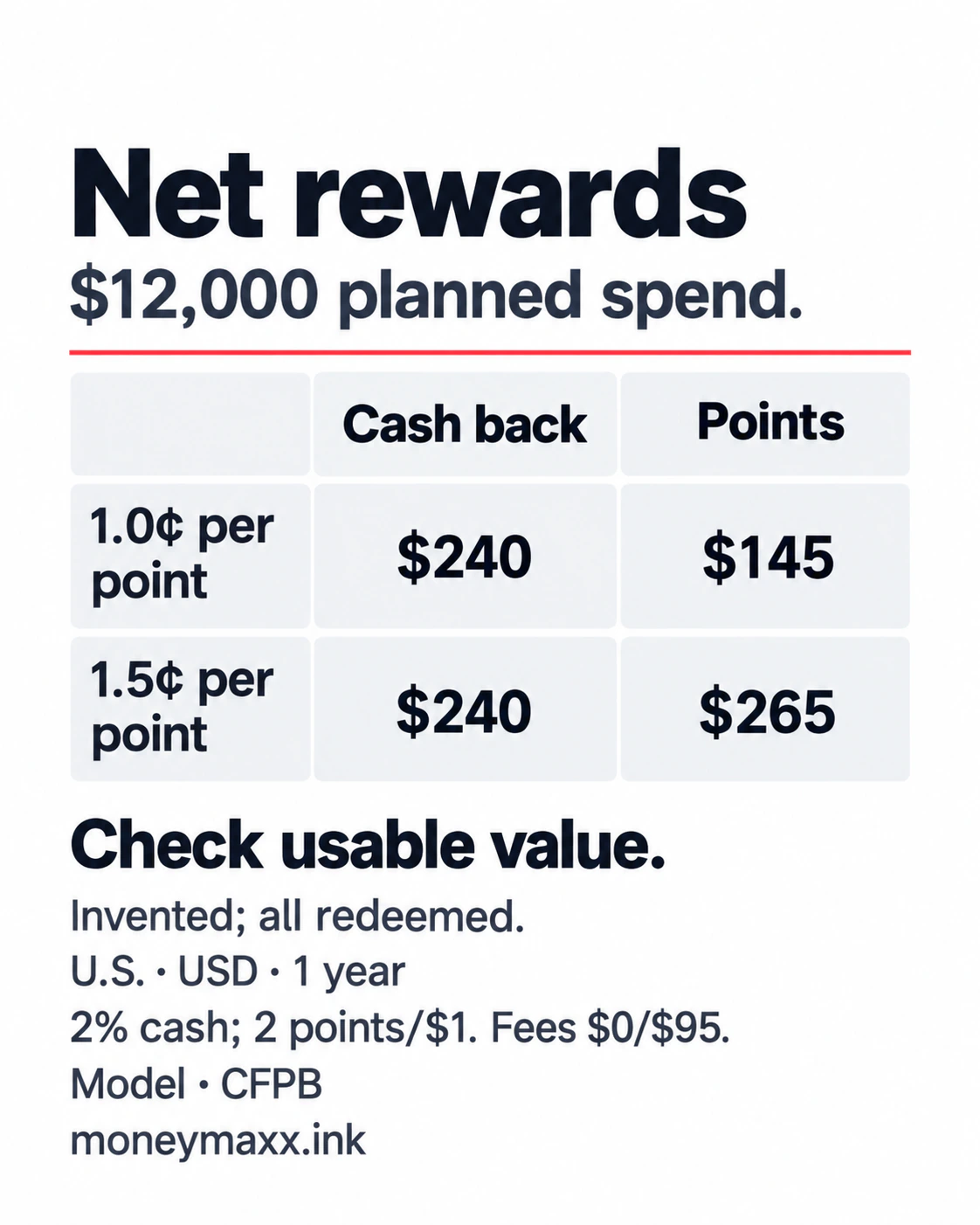
Consider $12,000 of already planned eligible spending during one year. Invent a cash-back option earning 2%, with no annual fee, and a points option earning two points per dollar with a $95 annual fee. Assume all earnings are redeemable during this comparison year. The cash reward is $240; the points balance is 24,000.
At an assumed gross redemption value of one cent per point, those points provide $240 before the fee, or $145 after it. The following rows change only the stated input from that base. The additional award-cash row uses gross point value, so its separate cash deduction is deliberate.
| Hypothetical annual case | Cash-back net benefit | Points net benefit |
|---|---|---|
| Base: one cent per point | $240 | $145 |
| Points worth 0.8 cents each | $240 | $97 |
| Points worth 1.5 cents each | $240 | $265 |
| Points annual fee removed | $240 | $240 |
| Add $50 of genuinely usable separate credit | $240 | $195 |
| Add $60 of incremental award cash costs | $240 | $85 |
| Only $6,000 of eligible spending | $120 | $25 |
| $24,000 of eligible spending | $480 | $385 |
| Add $300 financing costs to each option | -$60 | -$155 |
| No points redeemed in the comparison year | $240 | -$95 |
Net benefit here means rewards redeemed plus a usable separate credit, minus the stated annual fee, incremental redemption cash and financing costs. It does not mean income or profit from the purchases themselves. Both options still require paying for the underlying spending.
The $300 financing cost is an invented fixed cost input, not interest calculated from an APR, payment schedule or daily balance. It shows why positive gross rewards do not ensure a positive net result. The unredeemed-points row assigns no realised reward value in this year’s comparison; it does not establish that every unused point has expired or is permanently worthless.
This model excludes bonuses, inflation, tax, changing program terms, transaction-level rounding and the cost of your time. Whole-dollar eligible spending and uniform earning rates simplify the arithmetic. Actual category rates, caps and redemption rules can change the outcome. Higher spending appears as a sensitivity check, not a recommendation to spend more.
Who should choose each option
Cash back may suit someone whose verified redemption method is useful and whose actual costs are low relative to the reward. Check whether the benefit arrives as a statement credit, deposit or another form, along with any minimum and timing requirements. Keep paying according to the issuer’s statement and instructions rather than assuming that a requested reward has settled a required payment. Ask the issuer how a redemption affects the amount due.
Travel points may suit someone with an available redemption they value, enough eligible existing spending and a reason to pay any additional annual fee. A strong result for one planned booking does not give every point in a large future balance that same value. Check transfer and booking terms before an irreversible action; leave unknown restrictions unresolved.
Applying for neither may be appropriate when repayment, existing debt or missing terms matter more. Keeping an existing card can avoid an unnecessary new decision while you gather information. If considering closure or a product change, ask about the actual effect on existing rewards, fees and account arrangements first; this comparison predicts no credit-score change.
A booking check before an application
Consider Elena, a fictional reader with the existing no-fee cash-back option in the illustration. She sees that valuing 24,000 points at 1.5 cents produces a $265 annual benefit after the fee, $25 above the $240 cash-back result. Rather than applying on that estimate alone, she checks the travel she actually needs.
In this invented situation, the redemption she used to justify that value is unavailable on her required dates. She has not found an acceptable replacement, so the assumed 1.5-cent value has not been established for her comparison. She leaves the application undecided and keeps the existing card in the worksheet while requesting the missing redemption terms.
Elena has completed a useful step: testing whether a modeled advantage depends on an option she can actually use. This is not a claim that all points are worth less, that she can never travel on rewards, or that everyone should keep a particular account. Another available booking or a different fee could change the answer. Repayment capacity and the actual account conditions still need their own check.
Limitations and sources
The two hypothetical options are not current products. The illustration was reproduced in Python decimal arithmetic and a separate JavaScript integer implementation across 12 calculated scenarios and four rejected inputs. The checks include lower redemption values, added costs, smaller spending and cent rounding. Matching arithmetic does not validate a personal point valuation, approval probability or future redemption.
For an actual comparison, gather the current account disclosures and rewards terms, intended spending, next annual fee and a redemption you could use. Separate recurring value from promotional value, count restricted benefits conservatively and keep the existing-card option visible. Seek appropriate qualified debt or financial help if repayment or a consequential decision remains unclear.
There is no affiliate link, sponsor payment, referral benefit or claim of personal card testing here. This article provides general U.S. information, not personalised financial, tax or legal advice. It makes no guarantee about rewards, acceptance, savings, future program terms or your credit record. Historical guidance pages support the bounded educational points above; no CFPB circular is being represented as current binding law.
Sources
- S1 — CFPB, May 9, 2024: Credit Card Rewards. Report landing-page summary only; complaint themes, not population incidence.
- S2 — CFPB, reviewed September 23, 2024: What is a grace period for a credit card?. Conditional purchase grace periods and interest.
- S3 — FDIC, November 2021; page updated July 14, 2026: Credit Cards. Budget, fees and borrowing costs; an update date is not a new study.
- S4 — FDIC, March 2019; page updated December 12, 2022: Rewards Cards. Reward forms, earning, redemption and conditions. Its historical numerical examples are not adopted as current offers.
- S5 — FDIC, August 2024; updated August 5, 2024: Take Charge of Your Credit Cards. Fees, eligibility and account terms. Selected bodies were read on October 17, 2026; linked contracts and every related rule were not reviewed.
Topic hubs
Tags


