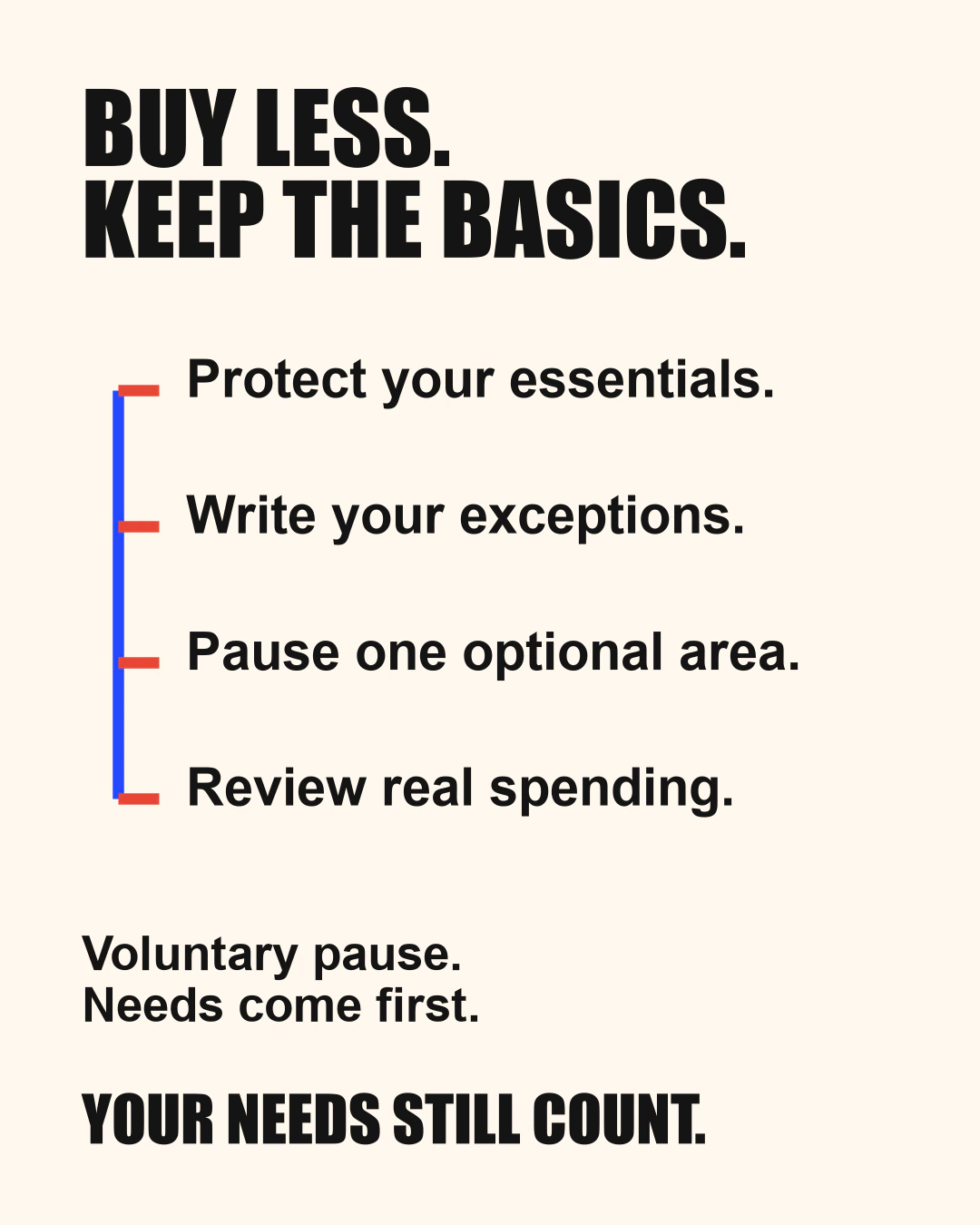
A $50 gift card and a $50 gift budget are different numbers. A purchase fee or delivery charge can make the card cost its giver more than the amount available to its recipient. A store restriction can make that balance less useful to someone who shops elsewhere. Before choosing the design, check the complete cost and where the gift can actually be used.
This guide is for U.S. adults choosing an optional personal gift, using USD and primary guidance checked October 26, 2026. It compares usability and giver cost, with invented calculations. It does not recommend an issuer, quote a current offer or determine anyone’s legal rights. Card terms and circumstances differ; a network logo alone does not answer every acceptance question.
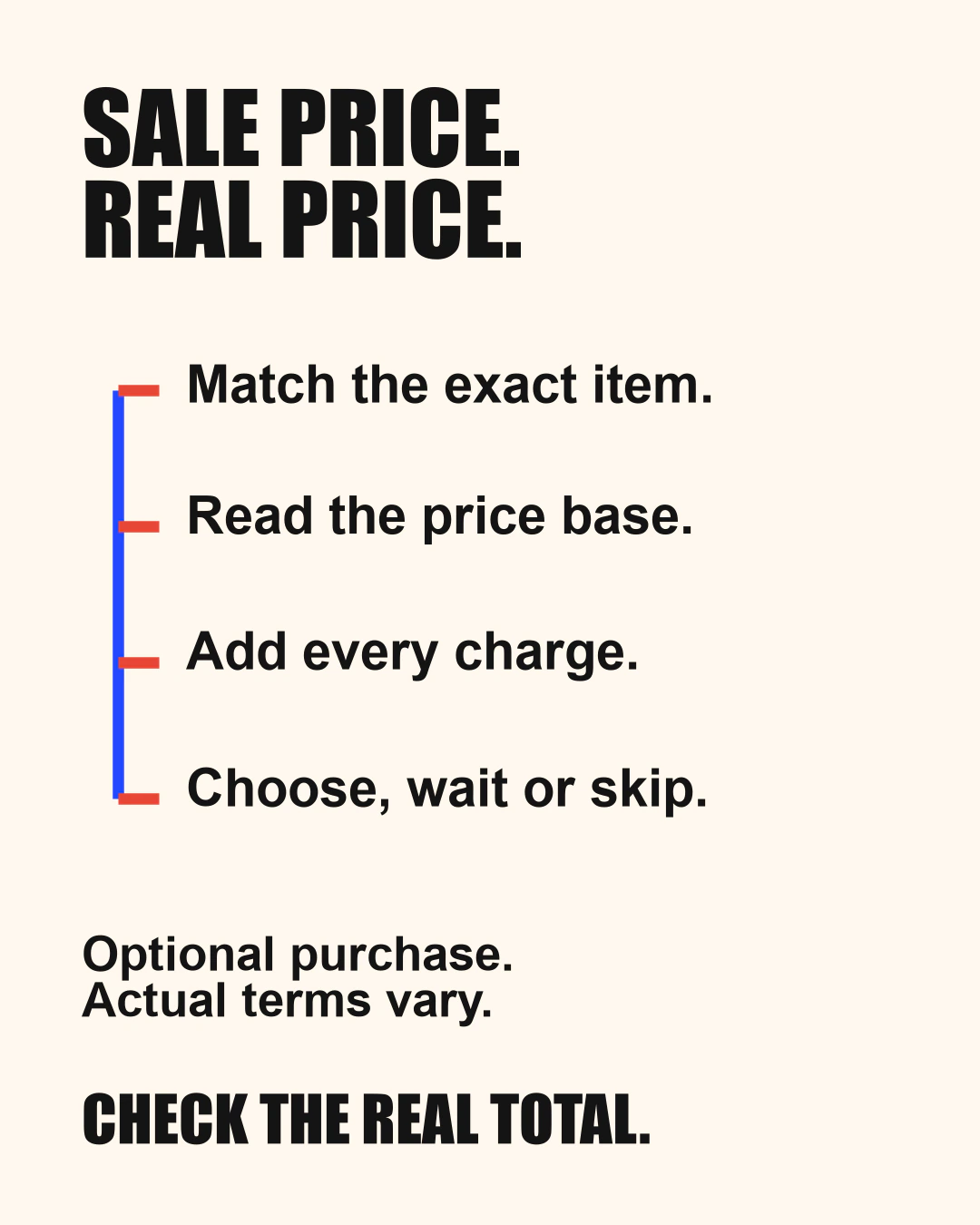
Qualitative U.S. gift-card overview, checked October 26, 2026: match the recipient, check accepted uses and complete giver cost, then choose, wait or skip. The rail shows reading order, not measured savings or guaranteed acceptance.
Text equivalent: Check whether the specific gift and its permitted uses suit the recipient. Read issuer and seller terms for actual merchant, online, geographic and other relevant restrictions; a network logo alone does not settle every checkout. Count the full giver payment separately from loaded card value and check the giver’s own current commitments. A suitable card, a different gift, direct cash under verified delivery assumptions, waiting or no purchase can be chosen. These are qualitative editorial reminders, not a promise of universal acceptance, refund, cash redemption, split tender, deposit insurance or personal affordability. Sources are original CFPB/FTC gift-versus-prepaid distinctions, federal MyMoney spending principles and Apple issuer-specific support; five documents span four publisher groups. United States/USD, October 26, 2026. Complete source links and limitations stay adjacent and in the sidecars.
Who this is for
Use these checks when deciding between a particular gift card, another suitable gift, cash where appropriate, or giving nothing now. The aim is a gift the recipient can use within an amount you have already decided is available. This article cannot establish that your household can afford that amount.
A card can be a thoughtful choice when it fits someone’s preferences. A restriction is not automatically a defect: a recipient might specifically want a card for a favorite shop. The problem is assuming that the number printed on any card works like unrestricted cash in every setting.
If someone directs you to buy cards and disclose their redemption codes to settle a bill, fine or emergency request, stop this comparison. That situation needs fraud checks, not a cheaper gift-card calculation. The FTC’s gift-card scam guidance describes that demand as a scam warning and explains how to report a problem.
Before you start
Write down the recipient’s likely use, the seller and issuer, the card type, its loaded value, every purchase or delivery charge and the complete amount you would pay. For a digital gift, check how it is delivered and whether the intended recipient can use that delivery method. Keep codes and personal details out of shared shopping lists.
Use your own current spending plan to set the giver limit. Bills, existing commitments and money reserved for other purposes still matter. A balance displayed in a banking app is not, by itself, a gift allocation. The federal MyMoney.gov spending principles support planning purchases and comparing price and quality; they do not supply a recommended holiday allowance.
Find the actual terms before paying. Check permitted merchants, online and in-store use, geographic restrictions, relevant fees, balance checking, replacement procedures and any conditions relevant to the recipient. Do not assume a refund, cash redemption, split payment or replacement will be available. Ask the issuer or merchant through a verified official channel when the terms leave a material question unanswered.
This guide gives no expiration period or inactivity-fee deadline. Those questions can depend on the product and applicable law. A promotional reward and a purchased gift card should not be assumed to follow the same rules. Check the specific terms and appropriate official consumer resources rather than applying a remembered rule to every card.
Actions in order
Match the card to a real use
Start with where the recipient actually wants to shop. A card for one retailer can fit well when the recipient already plans a suitable purchase there. It can fit poorly when using it would require an unwanted order, a special trip or spending above the gift value.
The CFPB’s card-selection guide distinguishes cards usable at limited locations from cards carrying a payment-network logo. It also distinguishes gift cards from other prepaid products. Do not borrow a reloadable prepaid account’s features or protections and assign them to a gift card that merely looks similar.
Use issuer information for the particular product. For example, Apple’s June 2026 gift-card warning explains that Apple gift cards are for purchases from Apple. This illustrates a use restriction, not a recommendation to buy that brand or a promise about every product, region or checkout.
An alternative gift also needs a practical check. Cash might suit a recipient, but delivery, security and preferences matter. A transfer service can introduce different charges and conditions. The cash example below assumes a direct gift with no transfer or delivery cost; it does not describe every way of sending money.
Keep loaded value separate from giver cost
Consider a fictional giver who has reviewed their own commitments and set aside $60 for this optional gift. That is an invented input, not a recommended amount or affordability judgment. All fees below are invented, and no issuer or seller is asserted to offer these terms.
| Fictional option | Recipient’s initial amount | Added giver charges | Giver pays | Left from $60 allocation |
|---|---|---|---|---|
| $50 card with no purchase or delivery charge | $50 card value | $0 | $50 | $10 |
| $50 card with a $5 purchase charge | $50 card value | $5 | $55 | $5 |
| Same $50 card, plus $3 delivery | $50 card value | $8 | $58 | $2 |
| Direct $50 cash gift, with no added cost | $50 cash | $0 | $50 | $10 |
| Give nothing now | $0 transferred | $0 | $0 | $60 |
In the first card example, $50 + $0 = $50. In the second, $50 + $5 = $55. Delivery changes the second total to $55 + $3 = $58. The recipient starts with $50 of card value in all three card cases. Paying more to acquire or deliver the card does not, under these assumptions, load extra money onto it.
The difference between the first and third totals is $58 - $50 = $8. That describes the giver’s invented extra cost. It is not a measured market fee, forecast loss or evidence that the recipient received a bad gift. A giver might knowingly value a particular product or delivery method. Compare that benefit with the complete charge.
The amount left is unspent gift allocation, not income. Giving nothing now leaves the fictional $60 unspent only if it has not been committed elsewhere. It creates no obligation to buy a replacement gift later.

Illustrative USD giver costs, checked October 26, 2026: the same fictional $50 loaded value costs $50 alone, $55 with an invented $5 purchase charge, or $58 with that charge plus $3 delivery. No current issuer fee or offer is shown.
Text equivalent: Every value is invented for teaching. All three bars contain fifty U.S. dollars of loaded card value in cobalt. The first giver pays $50 with no purchase or delivery charge. The second pays $50 value plus an invented $5 purchase charge, totaling $55; the charge is coral. The third pays $50 value plus $5 purchase charge and $3 delivery, totaling $58; delivery is near-black. The Value/Fee/Delivery key labels the components. Bars have equal widths, a shared zero baseline and seven pixels per exact USD, with no truncated axis or rounding. Paying acquisition or delivery charges does not increase recipient loaded value in this scenario. Other fees, taxes, financing and adjustments are excluded only from this model. Actual terms, suitable use and complete charges must be checked. The separately modeled $60 optional giver allocation is not a bank balance or affordability judgment; no purchase, remaining card credit, recipient extra tender and changed charges/value remain in the article. FTC/CFPB/MyMoney and issuer support do not supply these invented prices. United States/USD, October 26, 2026; no issuer recommendation, refund, cash redemption or loss forecast.
Check what happens after the first purchase
Suppose the recipient uses the fictional $50 card for an eligible purchase whose complete charge is $38. With no other charge or adjustment in this example, $50 - $38 leaves $12 on the card. That is a remaining balance, not proof of a $12 loss. Its usefulness depends on whether and how the recipient can use it under the actual terms.
Now suppose a different desired checkout totals $62. Against a $50 card, the gap is $62 - $50 = $12. This does not establish that the merchant accepts two payment methods or that the recipient wants to add their own money. Verify the checkout process. If the card cannot cover a suitable purchase on acceptable terms, a different gift may fit better.
Avoid an unwanted purchase just to empty a small balance. A balance check can help someone plan a suitable later use. Any right to redeem it for cash, and any threshold for doing so, needs product-specific and jurisdiction-specific verification. No such right or threshold is supplied here.
Test a changed assumption
If the invented purchase charge rises from $5 to $9 while delivery remains $3, the giver pays $50 + $9 + $3 = $62. That exceeds the fictional $60 allocation by $2. The overrun does not prove an overdraft or borrowing requirement: this example contains no bank balance or payment agreement.
A smaller fictional loaded value of $40, with the original $5 charge and $3 delivery, costs $48 and leaves $12 of the giver allocation. It also reduces the recipient’s initial card value by $10. A lower giver total is not automatically an equal gift. Keep those two changes visible rather than presenting the smaller card as an identical bargain.
Compare the two delivered cards directly: $58 for $50 of loaded value versus $48 for $40 of loaded value. The giver pays $10 less, and the recipient starts with $10 less. Purchase and delivery charges remain $8 in both cases. Under these assumptions, the lower giver cost comes entirely from giving less card value. Recalculate if the actual charges change.
If a promotion promises additional value, check its separate terms. An advertised bonus may have a different eligible use or other conditions. This guide does not assume a bonus exists or include one in the arithmetic. A comparison needs the specific product, complete charge and relevant restrictions.
Buy through a trusted route and keep the record
The FTC recommends trusted sellers, checking physical cards for tampering and retaining card information and receipts. If packaging or the protected code area looks compromised, choose another card and alert the seller. An inspection can identify warning signs; it does not guarantee that a card is safe.
For a digital gift, reach the genuine issuer or retailer independently instead of following an unsolicited discount message. Confirm recipient details privately. Store records securely: a redemption code can let someone spend the value, so the evidence you keep should not become a public screenshot.
The FTC’s payment-card comparison also distinguishes gift cards from other prepaid cards. This article uses that distinction only. It does not transfer that page’s general prepaid-account fees, credit protections or registration rules onto a particular gift product.

U.S. optional gift-card checklist, checked October 26, 2026: check recipient fit, actual use terms, complete giver cost and seller identity; keep redemption codes private. Stop for unclear material terms or someone demanding the codes as payment.
Text equivalent: Choose a specific gift that the recipient can use comfortably. Check actual permitted merchants and relevant product/checkout terms rather than assuming all prepaid-looking cards work alike. Add the giver’s complete acquisition and delivery charges, then compare them with a separately reviewed optional gift allocation and existing commitments. Verify the seller or issuer through a trusted independent route and protect redemption codes, card records and receipts. Stop an optional purchase for unclear material terms, an unverifiable seller, displaced essentials or unchosen recipient spending. A caller or message asking for redemption codes to settle an obligation is the separate fraud-warning situation described by the FTC; contact the supposed requester independently. Report problems promptly to the genuine issuer without assuming a refund or balance freeze. Suitable alternatives, waiting or no purchase remain available. The rail is ordered guidance, not a security guarantee or legal/financial clearance. United States/USD, October 26, 2026; source roles and full limitations remain adjacent.
Costs, risks and stop criteria
Checking terms takes time, and a gift that works for one recipient may not fit another. Consider complete acquisition cost, access to a useful merchant, extra spending needed for an intended purchase and how the recipient will track the balance. Do not assign a made-up probability to unused value or fraud.
Stop if the seller or issuer cannot be verified, important charges or restrictions remain unclear, the purchase would displace an essential commitment, or a suitable use depends on the recipient spending money they have not chosen to spend. A smaller gift, another gift or no purchase can be reasonable outcomes.
Also stop when a caller or message demands redemption codes as payment. Apple warns against giving codes to strangers; the FTC explains that someone who gets the numbers may spend the money while you still hold the card. Contact the supposed requester independently through a known channel. Contact details supplied by the suspicious message are not verification.
If codes were disclosed or a balance appears wrong, contact the actual issuer promptly through verified official contact information. Keep the receipt and relevant messages, and follow FTC reporting guidance. Ask about recovery, but do not assume a refund or freeze is guaranteed. This guide provides no legal determination or individualized recovery plan.
How to assess the result
For the giver, compare the recorded complete payment with the amount set aside. Keep recipient value and acquisition charges in separate columns. A correct budget total does not establish that the card fits the recipient, and a happy recipient does not make an omitted charge disappear.
For the recipient, a useful outcome is an eligible purchase they want, with a known charge and a balance they can track. They should not need to disclose a code publicly or buy something unwanted to make the gift look successful. A remaining balance can still be useful; record it before deciding what to do next.
The question is whether this gift can be used comfortably on terms both people understand. The design, network logo and face value are starting points. Complete cost, suitable use and secure handling finish the decision.
Myth or Real?
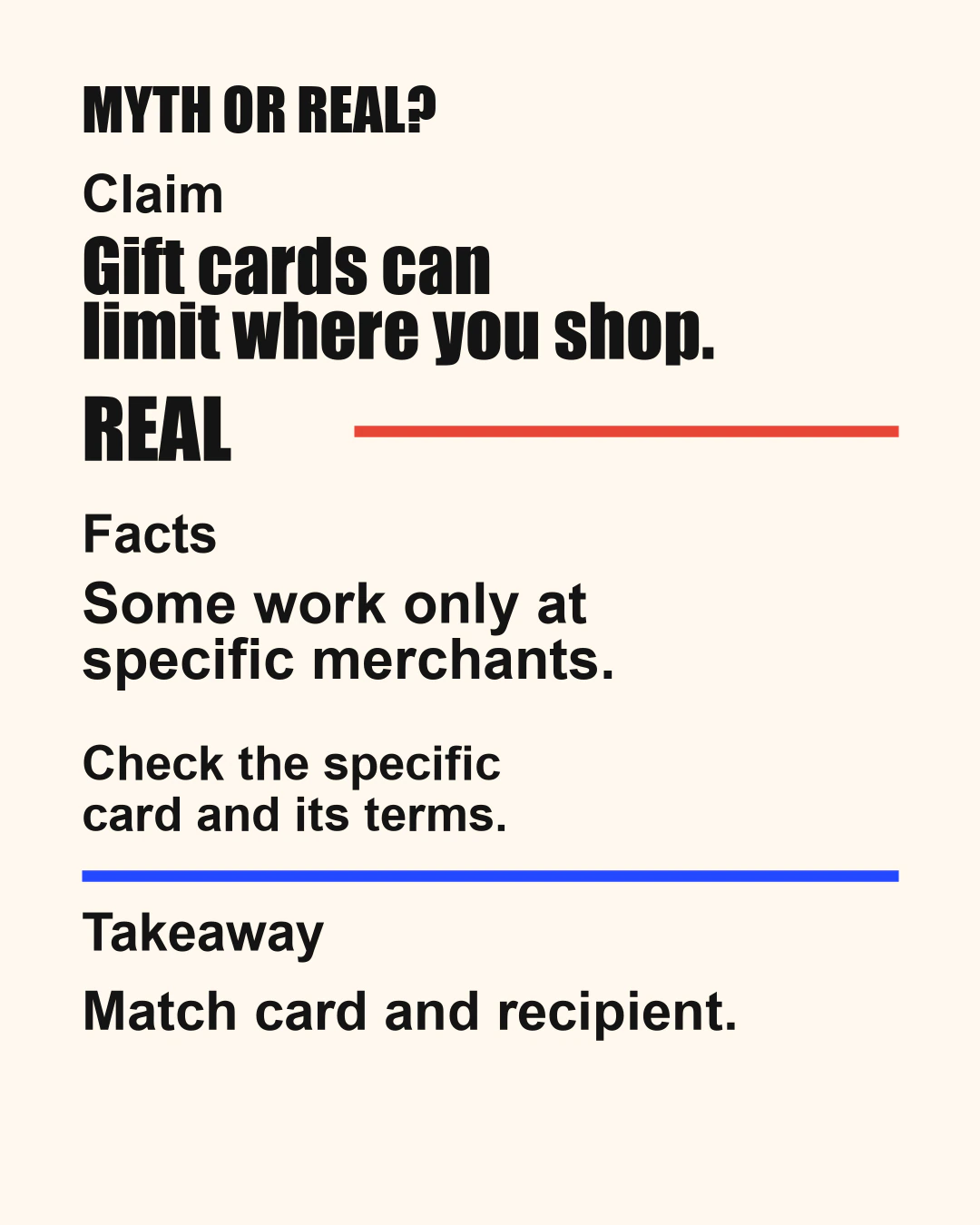
Claim
Social paraphrase: Gift cards can have spending restrictions that make them less flexible for some purchases.
Verdict
REAL
Facts
Some gift cards restrict spending to specific merchants or locations.
Check the exact card and terms. This confirms possible use restrictions, not that all gift cards are worse or cash is accepted everywhere.
The original social poster raises gift-card flexibility and also appreciates store cards suited to the recipient. That post discovers the question; it does not verify reader errors or prove that all gift cards are inconvenient. CFPB distinguishes cards usable at broader payment-network locations from cards restricted to certain merchants or locations, and treats gift cards separately from general prepaid products. Apple provides a concrete issuer-specific example: its gift cards are for its own products and services. These primary sources support the qualified possibility of merchant restrictions in the graphic. They do not establish how common a problem is, universal loss of leftover credit, inability to combine payments, cash acceptance everywhere or a guaranteed refund or redemption right. Check the exact product and current terms; fees and payment options vary. No issuer endorsement is implied. All dollar amounts in the separate worked article examples remain invented, not prices or findings supplied by these sources.
Takeaway
Match the card and its permitted uses to the recipient before choosing, waiting or skipping an optional gift.
Sources
Claim discussion: Original social discussion of gift-card spending flexibility.
Evidence: Choose the right card for your situation; About gift card scams.
Checked 2026-10-26. Scope: United States gift-card consumer guide, USD context. Merchant/use restrictions only. No observed fee, loss, legal deadline, guaranteed refund, split tender, cash redemption, affordability or universal cash-acceptance claim. Apple issuer guidance is not an endorsement or independent study.
Sources
General U.S. consumer education in USD, checked October 26, 2026. The horizon is acquisition, delivery and the next eligible use. All amounts, charges and allocations are original fictional inputs. Taxes, financing, later fees and other charges are excluded only within the examples; actual terms need checking.
Five original documents span four publisher groups, not five independent studies. Publication dates remain distinct from access dates. Apple is a commercial issuer describing its own product, not an independent comparison. No retailer, issuer, affiliate or sponsor pays for placement or ranks options here.
- FTC: Avoiding and Reporting Gift Card Scams, July 2023: trusted buying, tampering, private codes, receipts and reporting.
- CFPB: Choose the right card for your situation: limited versus broader acceptance and gift-card distinctions; no legal protections or fee schedule transferred.
- MyMoney.gov: Spend: general spending plans and comparing price and quality, applied to the giver’s optional purchase.
- Apple: About gift card scams, June 24, 2026: issuer use restriction and private-code warning, without endorsement.
- FTC: Comparing Credit, Charge, Secured Credit, Debit, or Prepaid Cards, January 2025: gift-card distinction only; unrelated credit, debit and prepaid-account rules are outside this guide.
FAQ
Common questions
Does paying more for a gift card give its recipient more value?
Not necessarily. In the invented example, a $50 card plus $5 purchase charge and $3 delivery costs the giver $58 while loaded value remains $50. These are fictional charges, not a current offer.
Is remaining card credit a loss?
No. In the fictional example, a $38 eligible checkout leaves $12 on a $50 card. That is remaining credit; its usefulness depends on actual terms and suitable later use. No universal cash-redemption or split-tender right is asserted.
Does the example recommend a $60 gift budget?
No. It is a fictional separately reviewed optional allocation, not a personal affordability judgment or bank-account balance. Check your own commitments and consider a different gift, waiting or no purchase.
Topic hubs
Tags